Archive for August, 2008
August 31st, 2008
Continuing my twitter experiment from April, May, June, and July I have continued to select a quote every couple of days that I believe is applicable to the challenges of entrepreneurship. Here are my choices for August:
“Be wary of the man who urges an action in which he himself incurs no risk.”
Joaquin Setanti
A lot of VC advice pre-investment falls into this category. Like the primitive tribe that didn’t have a word for “no” VC’s rely on “why don’t you try this shiny new business area instead of your current plan.” Potential partners and prospects can also ask you to make additional investments in a potential relationship without putting any of their own intellectional, social or financial capital at risk. At a minimum you should get agreement on an “acceptance test” in advance that allows you to determine what result will impel them to go forward. It can appear more encouraging when you hear “I’ll have to get back to you on that,” since it allows you to live in hope–for a while–but tends to encourage inaction as founders savor the illusion of traction.
“There is in the worst of fortune the best of chances for a happy change.”
Euripides
Cultivating calmness in a crisis enables an entrepreneur to see opportunities inherent in the “creative destruction” of capitalism.
“We notice the ripple and take the lake for granted”
John Seely Brown & Paul Duguid in “The Social Life of Information“
Marshall Mcluhan observed that “We don’t know who discovered water, but we know it wasn’t the fish.” One challenge for entrepreneurs seeking a disruptive business model is to invert their focus from trends to constants. It’s easy to focus on what’s new, it’s hard to see how something permanent might be catalyzed or transformed.
“My future starts when I wake up every morning. Every day I find something creative to do with my life.”
Miles Davis
“Don’t judge each day by the harvest you reap, but by the seeds you plant.”
Robert Louis Stevenson
“To be able to look back upon one’s past life with satisfaction is to live twice.”
Martial
August 25th, 2008
Negotiating a software deal, from either side of the table, can be different from many other negotiations that you enter into. I have been surprised over the years at how folks who are successful in other domains can fail one or more of the following tests as they negotiate a software deal.
- Have You Created the Basis for an Ongoing Relationship?
Software is the Promise of a Relationship: software typically involves getting your custom information into a new format (or creating information you would later like to translate into other formats) and almost always involves process and habit changes. The expectation on the vendor side is that the customer will contribute not only bug reports and enhancement requests but also additional maintenance and/or license fees over time. The customer expects the vendor to continue to maintain and enhance the product in response both to general changes in the environment and to specific requests from customers. If the negotiation leaves such ill feeling on one or both sides that a mutually beneficial relationship is out of the question, it’s not a good deal.
- Have You Assessed Both Yours and the Other Party’s BATNA?
In their 1981 book “Getting to Yes” Roger Fisher and William Ury coined the term “Best Alternative To a Negotiated Agreement” which they abbreviated BATNA. Both sides have a BATNA. It describes the status quo ante or likely result for a side if an agreement cannot be negotiated. You must continually assess not only the other side’s BATNA but your own as well.
- Explore the other side’s perception of their BATNA from the beginning. Their perception of their options will shape their negotiating position.
- Be careful in multi-way negotiations as a smaller firm, you may have been brought in just to give the appearance of adding a key feature or a lower price to the other side’s BATNA. For example, your offer may be used to induce another bidder to cut price.
- Are You Considering Something That Must Be Kept Secret After The Deal is Signed?
Assume everyone finds everything out! It’s rare that a negotiating ploy can be kept secret over the long run. Active misrepresentation in particular can be destructive to any ongoing relationship. However, you are not testifying during a negotiation: while I believe that you should tell the truth and nothing but the truth, you don’t have to tell everything that you know.
- Don’t assume that the other side is telling the whole truth: trust but verify.
- In “Negotiations and Resolving Conflicts: an Overview” Prof. Edward G. Wertheim of Northeastern University includes this guideline from a British Foreign Service Manual on diplomatic negotiation: “Nothing may be said which is not true, but it is as unnecessary as it is sometimes undesirable to say everything relevant which is true; and the facts given may be arranged in any convenient order. The perfect reply to an embarrassing question is one that is brief, appears to answer the question completely (if challenged it can be proved to be accurate in every word), gives no opening for awkward follow-up questions, and discloses really nothing.”
August 23rd, 2008
I spent the morning helping to facilitate a strategic planning meeting for PATCA. I was asked by Walt Maclay, the current PATCA president, to assist him and the board of directors (and any PATCA members how wanted to take part) in charting a course for 2009.
PATCA is a Silicon Valley institution, a non-profit founded in 1975 specifically to help connect businesses with independent consultants. It’s older, for example, than the Software Development Forum (SDForum started out as the Software Entrepeneur Forum in 1983) and the Silicon Valley Association of Software Entrepreneurs (SVASE) which was founded in 1995. An unlike either of those organizations it’s entirely member supported, it doesn’t rely on corporate sponsorships to fund any of its programs or activities.
A number of experienced and articulate consultants attended and contributed.
Strategic planning covers a multitude of sins, my contribution was to suggest the group review a couple of key questions:
- Analyzing the budget for the organization, do the priorities implied by where you are spending your money match the priorities of the organization and it’s mission.
- Is the organization encouraging, fully utilizing, and recognizing the volunteer energy that makes any non-profit successful.
- What are the key metrics for assessing how well the organization is fulfilling its mission? If this were a business, they would be what Jack Stack might call “the critical numbers.”
I came away impressed with everyone who contributed and in particular how well the finances were managed. Having some exposure to non-profit finances over the years, it’s one area where hard choices can often be postponed to the detriment of an organization’s long term viability.
Not a bad way to spend a Saturday morning.
August 20th, 2008
Robert May concludes his post on “Entrepreneurship: Don’t Drink the Kool-Aid” with the following
If you want to be an entrepreneur, stop believing that ideas matter. That isn’t what entrepreneurship is about. Entrepreneurs aren’t idea people, everybody and their brother has ideas. Entrepreneurs are people that exploit ideas by matching them to market needs, executing them despite scarce resources and designing a business model that makes the idea profitable.
If you want to be an entrepreneur, stop waiting. Start doing something. That is how you learn. Make entrepreneurship your hobby, until you can make it your career.
This is a very common situation for folks with an inventive or entrepreneurial frame of mind (note that the two are different). A couple of suggestions if you are a “geyser of ideas” (as Adrian Monk says “it’s a blessing…and a curse”):
- Write them down and flesh them out to at least a paragraph or two.
- Focus on who the customer is and the pain that you are alleviating.
- Keep them sorted by your desire to work on them.
- Share the top 10-20% in face to face and small conversations, see if you get any interest.
- Give the rest of the ideas away (e.g. blog about them, post them) in such a way that people can contact you if they are interested. Don’t worry, next month you will have more ideas. And next year even more.
August 19th, 2008
Networking and referrals continue to be the primary marketing strategy for many community-based small businesses (especially those with limited budgets). In contrast, many technology-oriented small businesses rely more upon on-line forums, social networking sites, user groups, etc. to reach potential customers. I sometimes wonder if more old-fashioned ’schmoozing’ skills can help these companies get more customers–especially here in Silicon Valley?
First, we need to remember that networking and referrals are really two different things:
- Networking is the act of putting yourself in an environment to meet and interact with others.
- Referrals are what happens when someone introduces you to a third party who might benefit from what you have to offer.
I guess it’s a little like dating. You go to a dance to socialize with others (i.e. networking) and hope to get introduced to someone with similar interests (i.e. a referral).Getting a referral from someone is very special. They are sharing their credibility by referring you to someone you may not even know. They are essentially validating that you are real, credible and can do what you say you can do. This short-circuits the sales cycle considerably. While some referrals are nothing more than warm leads others can be considerably hotter!
So how can we all do a better job of getting referrals?
- The first step is to get out there and show up where everyone else in your industry goes. Sure there are a lot of referrals made using emails and over-the-phone but many more are made during face-to-face meetings.
- The second step is to give more referrals! The old adage that ‘givers gain’ is so appropriate. Go out of your way to refer your customers, partners and associates to others who could benefit from their services. After awhile you’ll notice them reciprocating and everyone wins.
- The third step is to simply ask for them. It is amazing how many business owners shy away from ever reminding their satisfied customers that their referrals would be much appreciated. I would also take things further and make referrals a strategic goal instead of a casual thing that either happens or it doesn’t.
Certainly referrals should not be your only marketing strategy to get more clients but it sure seems like every other strategy takes more time, costs more money and rarely gets the results that a dedicated networking/referrals strategy does.
August 18th, 2008
Last week I attended Marketing Strategies in a Down Economy by Steve Moore. Steve stressed the importance of why you are different than your competition. One key differential can just be the reason why you started your business: what is the passion you bring to this business?
Following that meeting, I updated our website home page. Here are the questions I hope our home page answers:
- Who we are?
- What we do?
- What type of clients we work with?
- What type of projects we take on?
- Why we started this business?
- Why existing clients use us?
This should be a good list for most businesses.
August 17th, 2008
I am always surprised by how many basic mistakes CEOs make when giving demos. Learn to avoid them at Cohan’s Great Demo workshop.
- Starting the demo with your company history … who cares?
- Too many bullets on one slide. See Guy Kawasaki’s 10/20/30 Rule of Powerpoint
- “Why I should care about your product” is left to the end of the presentation (long after the high level execs have left the room).
- Live demo that does not work.
- Detailed explanation of every product feature. Regardless if the audience want to see them or not. Gear it to your audience, ask them if you don’t know.
This is an interactive workshop with Peter Cohan geared especially for startup entrepreneur. If you bring a copy of your demo, we will review it in the workshop and provide you feedback on how to improve it.
“SKMurphy’s partnership with the Second Derivative has allowed entrepreneurs at smaller firms access to the same world class sales training normally only available to Fortune 1000 companies. In the class my team developed a presentation that allowed us to explain our offering much more clearly to our prospective customers.” said Miles Kehoe, President at New Idea Engineering. “We have also reshaped how we help our clients present results to their end users. The temptation so often is to start at the beginning of the story and tell them here’s what we did first…then we did this…and really the only thing the they care about is the results, the improvements they will see.”
Postscript Aug 18: I struck a chord with Chris Edwards, who saw parallels between poor demos and poor press briefings, causing him to ask the question “Does Anybody Enjoy Presentations?” Some excerpts follow:
Basically, all these presentations are done backwards. Point three in the SKMurphy list is the most important one for me: “‘Why I should care about your product’ is left to the end of the presentation.”
Many briefings are like some ghastly cross between company brochure and time-share sales. Most presentations make you feel like you’re being set up for a con. There is slide after slide of selective evidence, all meant to make you think that the thing to be unveiled at the end is the answer.
[…]
People really need to think about the thought processes that their intended audience are likely to use. A journalist is, in the case of a briefing, looking for a story. They may well not take away the story you presented but if you start off with what you think the story is, things might at least unfold in the right order.
So, make the claim early. And then provide the background for why this claim might be true. And then you can move onto the background. Why this way round? Because it’s a structure that fits the inverted pyramid of news; it fits the thought processes that journalists are most likely to use: what’s happened; how it happened; evidence to back it all up.
This is the reality of most demos as well, you have to convince the prospect in no more than a few minutes that you can help them in a meaningful way. And the first part runs more reliably on PowerPoint as a platform than Linux, so hold off on the interactive portion until you have established very clearly what the value for your audience is.
August 13th, 2008
We’ve recently expanded the website to add a Startup Stages area that organizes the content based five distinct stages of evolution for a startup. It’s designed to offer you a perspective on content that’s directly relevant to your needs based on the logical next steps to build on what you have achieved. It’s an effort on our part to stand in our customer’s shoes and present what’s immediately relevant to their needs. Like anything else on this site it’s still under construction but far enough along we welcome your feedback by e-mail, comment, contact form, or phone; whatever is easiest for you.
August 9th, 2008
One of the strategies we cover in our Getting More Customers workshops is blogging.
Below is a 90-plan developed by a workshop attendee last year, anonymized and presented with permission. Actual implementation took more than 90 days but he has been blogging for a little less than a year and has 60 blog posts that have been gathering readers. He also uses the blog to answer questions that keep coming up, treating it like a FAQ in progress.
Any good action plan builds on your existing strengths and successes. If you are comfortable with writing, a blog is a good way to gently remind your prospects that you are out there and are available to help them when they have a problem.
Here is the blank worksheet he filled out, answers in italic
One Page Customer Development Plan
Chose the techniques you are going to implement and have a plan! Figure out how you are going to measure it and track the outcome.
Objectives:
- Who are the NEW customers you want to attract?
want to target customers in financial space
- How will you develop NEW business?
use blog as a way to reach and influence prospects
- How will you grow EXISTING business?
same
90-day Plan
2 weeks: Identify blogs where I can guest blog or comment on4 weeks:
- Select blog software and domain name
- Check out at typepad, wordpress, blogger
- Does my hosting service have one?
- Comment on other blogs - 3 times/week (Can I keep this up?)
8 weeks:
- Develop a plan for one/week blogging topics
- Start writing one blog per week
13 weeks:
- Start my blog
- Write one blog a week on my blog
- once a week comment on someone else blog (linking to my)
We checked in with him briefly at each of the milestone dates (basic follow-up is included in the workshop fee) and recently spoke with him now that he has been blogging for about 10 months to get his assessment of the results achieved.
I got busy so it took about 5 or 6 months to do. It takes a lot more planning, reading and thought than I anticipated that it would and readership is smaller than I would like (at least compared to our newsletter). I need to get better at commenting on other blogs. When I am busy this is the first thing to fall off, yet it is critical to building my readers. I have seen it boost my website traffic but I have not seen it generate sales leads directly yet. It was been useful to answer inquiries we get by writing a blog post, and doing this has made them easier to re-use. It’s also been helpful when we wanted to respond quickly to an event (e.g. an acquisition) that our customers and prospects are looking for a quick take on. But it’s a different writing style from a forum post or a newsletter article that requires practice to master.
August 6th, 2008
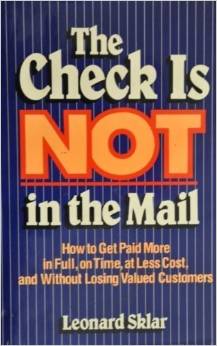
Len Sklar joins us in Milpitas this Friday, he will make a short presentation on “The Check is Not in the Mail” and answer questions on effective approaches to getting paid in full, on time, at less cost and without losing valued customers. Len came to our March 7 breakfast and facilitated some very well received interactive exercises: several bootstrappers in turn took the role of a delinquent customer and Len demonstrated a variety of low key techniques to move beyond a current deadlock.
RSVP and bring your questions Friday August 8 to the Omega Restaurant in Milpitas.
Previous Posts