
A collection of quotes for entrepreneurs curated in December 2025 around a theme of wonder, awe, and miracles.
Quotes for Entrepreneurs Curated in December 2025
I curate these quotes for entrepreneurs from a variety of sources and tweet them on @skmurphy about once a day where you can get them hot off the mojo wire. At the end of each month I curate them in a blog post that adds commentary and may contain a longer passage from the same source for context.
My theme for this month’s “Quotes for Entrepreneurs” is wonder, awe, and miracles.
+ + +
“Mystery is a very necessary ingredient in our lives. Mystery creates wonder and wonder is the basis for man’s desire to understand. Who knows what mysteries will be solved in our lifetime, and what new riddles will become the challenge of the new generations?”
Neil Armstrong in Joint Meeting of the Two Houses of Congress to Receive the Apollo 11 Astronauts (16 Sep 1969)
+ + +
“A display connected to a digital computer gives us a chance to gain familiarity with concepts not realizable in the physical world. It is a looking glass into a mathematical wonderland.”
Ivan E. Sutherland The Ultimate Display (1995)
Simulation models coupled with computer visualization technologies allow us to not only make our imagination visible but generation thought-provoking representations of the implications of our hypothesis that can restore our sense of wonder. Here is a longer excerpt from Sutherland’s essay:
“We live in a physical world whose properties we have come to know well through long familiarity. We sense an involvement with this physical world which gives us the ability to predict its properties well. For example, we can predict where objects will fall, how well-known shapes look from other angles, and how much force is required to push objects against friction. We lack corresponding familiarity with the forces on charged particles, forces in non-uniform fields, the effects of nonprojective geometric transformations, and high-inertia, low friction motion. A display connected to a digital computer gives us a chance to gain familiarity with concepts not realizable in the physical world. It is a looking glass into a mathematical wonderland.”
Ivan E. Sutherland in the opening paragraph of The Ultimate Display (1995)
+ + +
“Human beings must always be on the watch for the coming of wonders.”
E. B. White in “Charlotte’s Web”
+ + +
“Every transformative company starts with someone spotting a crack between the story everyone believes and what’s actually happening Instead of brushing it off as noise, they treat it like a clue. Then they build a completely new explanation.”
Mike Maples
He refashioned this tweet into
“Here’s the mechanism I keep noticing: Every genuinely transformative company I’ve come across starts with someone spotting a crack between the story everyone believes and what’s actually happening on the ground. Instead of brushing it off as random noise, they treat it like a clue. Then they build a completely new explanation. Sometimes it’s rough at first and needs to be further refined, but it ends up reshaping how people see reality.”
Mike Maples in “Why I’m Supporting Conjecture“
Peter Thiel outlined this approach in “Zero to One.” What Maples calls “cracks” Thiel calls ‘secrets” which he defines as “an important truth very few people agree with you on.” Thiel devotes Chapter 8 of “Zero to One” to secrets, closing the chapter with “we have given up our sense of wonder at secrets left to be discovered.”
In “Innovation and Entrepreneurship,” Peter Drucker suggests that you develop innovative business ideas by searching for changes that have already occurred but where the full effects have not been felt. He lists seven sources for innovative ideas in decreasing order of importance:
- The Unexpected (e.g. unexpected success or failure of an existing product or service)
- The Incongruous
- Weak Link In Existing Process
- Industry Or Market Structure Change
- Demographics: Size, Age Structure
- New Zeitgeist: Perception, Mood, Meaning
- New Knowledge
+ + +
moonlit winter trees
bare branches paint gray shadows
ghostly risen roots
Guillemets curates The Quote Garden. This haiku provoked my sense of wonder.
+ + +
“Whenever I get gloomy with the state of the world, I think about the arrivals gate at Heathrow Airport. General opinion is starting to make out that we live in a world of hatred and greed, but I don’t see that. It seems to me that love is everywhere.
Often, it’s not particularly dignified or newsworthy, but it’s always there: fathers and sons, mothers and daughters, husbands and wives, boyfriends, girlfriends, and old friends.
When the planes hit the Twin Towers, as far as I know, none of the phone calls from the people on board were messages of hate or revenge; they were all messages of love. If you look for it, I’ve got a sneaky feeling you’ll find that love actually is all around.”
Opening monologue in “Love, Actually” written by Bill Curtis
I used this as the opening quote in Merry Christmas 2025.
+ + +
“Wonder rather than doubt is the root of all knowledge. […] Wonder is a state of mind in which we do not look at reality through the latticework of our memorized knowledge; in which nothing is taken for granted.”
Abraham Joshua Heschel in “Man is Not Alone” (1951).
+ + +
“Winter is also inherently liminal with a memory of Autumn, and the hope of Spring.”
Andrew Shindyapin (@ph0rque)
Andrew took part in a Q&A in October 2025: “Andrew Shindyapin: AI’s Impact on Software Development.” I have featured several of his quotes over the years, including this one from August 2016: “Nothing is as painful, or as necessary, as peeling off one’s own layers of self-deception.”
+ + +
Two conversations this weekend make me think that there’s a vibe shift afoot in Silicon Valley around what one should work on and what is worthwhile.
[…]
Overall, “what is worthy and valuable?” feels like it’s becoming more central.
Patrick Collison (@patrickc) in a Dec-8-2025 tweet
My reply: “To whom much is given, much shall be required: to whom men have committed much, of him they will ask the more.” Luke 12:48 Successful entrepreneurs must commit to finding common ground and leadership driven by humane values. The center must hold for all of our sakes.
+ + +
“The system is not what we design. The system is what people do.”
Russ Miles in “The Map that refused to stay still“
A clever restatement of
“The purpose of a system is what it does. There is after all, no point in claiming that the purpose of a system is to do what it constantly fails to do.”
Stafford Beer in “Diagnosing the system for organizations“
I think Beer’s insight offers a caution to entrepreneurs designing systems for their startup and attempting to create a culture. Your intent in crafting a set of guidelines or rules is necessary but not sufficient. Equally important as the mechanisms you design to enforce your rules, your willingness to make the tough calls, and how employees react to your enforcement. Key decisions in establishing culture are who your hire, who you fire, and who you promote.
Understanding systems requires a clear-eyed view of what’s actually happening. This allows you to incorporate side effects and compare unintended consequences with planned outcomes. A clear-eyed view can uncover the unexpected and the seemingly inexplicable, inspiring a sense of wonder, or frustration, or a mixture of both. If it’s a system you designed you need to distinguish between your intent and the outcomes the system delivers.
I used this as the closing section “Caution: Stated Intent is Defeated by Real Incentives and Effect of Your Actions” for “Manage Communication and Coordination to Achieve Synergy.”
+ + +
“Our senses enable us to perceive only a minute portion of the outside world.”
Nikola Tesla in The Transmission of Electrical Energy Without Wires As a Means for Furthering Peace (January 7th, 1905)
Our Umwelt is the environment we perceive with our sensory organs and perceptual systems. Wonder is an expansion of our umwelt.
+ + +
“Ignorance is not the cause of reverence. The unknown as such does not fill us with awe. We have no feelings of awe for the other side of the moon or for that which will happen tomorrow.”
Abraham Joshua Heschel in “Man is Not Alone” (1951)
+ + +
“We crave for new sensations but soon become indifferent to them. The wonders of yesterday are today common occurrences.”
Nikola Tesla in “My Inventions V – The Magnifying Transmitter” (1919) in the Electrical Experimenter
More context:
In investigating the behavior of high frequency currents I had satisfied myself that an electric field of sufficient intensity could be produced in a room to light up electrodeless vacuum tubes. Accordingly, a transformer was built to test the theory and the first trial proved a marvelous success. It is difficult to appreciate what those strange phenomena meant at that time. We crave for new sensations but soon become indifferent to them. The wonders of yesterday are today common occurrences. When my tubes were first publicly exhibited they were viewed with amazement impossible to describe.
Nikola Tesla in “My Inventions V – The Magnifying Transmitter” (1919) in the Electrical Experimenter
+ + +
“In truth, landscapes of great wonder and beauty lie under our feet and all around us. They are discovered in tunnels in the ground, the hearts of flowers, the hollows of trees, freshwater ponds, seaweed jungles between tides, and even drops of water. Life in these hidden worlds is more startling in reality than anything we can imagine on other planets. Some of Earth’s own inhabitants are almost too startling for belief. They are graceful and gentle; they are horrible monsters; they are giants— or dwarfs. They communicate with each other by devices that are far beyond the reach of our senses. […] How could this earth of ours, which is only a speck in the heavens, have so much variety of life, so many curious and exciting creatures?”
Walt Disney in the forward to “Secrets of Life: a True Life Adventure” (1957)
The book is based on the “Secrets of Life” film written and directed by James Algar.
+ + +
“Many of the cemeteries are beautiful, and are kept in perfect order. When one goes from the levee or the business streets near it, to a cemetery, he observes to himself that if those people down there would live as neatly while they are alive as they do after they are dead, they would find many advantages in it; and besides, their quarter would be the wonder and admiration of the business world”
Mark Twain “Life on Mississippi” in Chapter 42 “Hygiene and Sentiment”
Mark Twain’s impressions of New Orleans. More context:
“They bury their dead in vaults, above the ground. These vaults have a resemblance to houses—sometimes to temples; are built of marble, generally; are architecturally graceful and shapely; they face the walks and driveways of the cemetery; and when one moves through the midst of a thousand or so of them and sees their white roofs and gables stretching into the distance on every hand, the phrase ‘city of the dead’ has all at once a meaning to him.
Many of the cemeteries are beautiful, and are kept in perfect order. When one goes from the levee or the business streets near it, to a cemetery, he observes to himself that if those people down there would live as neatly while they are alive as they do after they are dead, they would find many advantages in it; and besides, their quarter would be the wonder and admiration of the business world. Fresh flowers, in vases of water, are to be seen at the portals of many of the vaults: placed there by the pious hands of bereaved parents and children, husbands and wives, and renewed daily.
A milder form of sorrow finds its inexpensive and lasting remembrancer in the coarse and ugly but indestructible immortelle, a wreath or cross or some such emblem, made of rosettes of black linen, with sometimes a yellow rosette at the conjunction of the cross’s bars—kind of sorrowful breast-pin, so to say. The immortelle requires no attention: you just hang it up, and there you are; just leave it alone, it will take care of your grief for you, and keep it in mind better than you can; stands weather first-rate, and lasts like boiler-iron.”
Mark Twain Life on the Mississippi Chapter 42 “Hygiene and Sentiment”
+ + +
“A man is known by the Christmas he keeps.”
“Poor Richard Junior’s Philosophy,” The Saturday Evening Post, 1904, George Horace Lorimer, editor
+ + +
Christmas is more than a time of music, merriment, and mirth;
It is a season of meditation, mangers, and miracles.Christmas is more than a time of gaiety, greenery, and gifts;
It is a season of wonder, worship, and wise men.Christmas is more than a time of tinsel, trees, and toys;
It is a season of preparation, prayers, and peace.Christmas is more than a time of festivities, family, and friends;
It is a season of generosity, gladness, and gratitude.Christmas is more than a time of carols, cards, and candy;
It is a season of dedication, direction, and decision.Christmas is more than Santa, stockings and surprises;
It is Christ, caring, and concern.Christmas is more than parties, presents, and pleasures;
It is a star, a stable, and a Savior.
I like the way he juxtaposes the celebration and spiritual aspects of Christmas. I initially discovered this couplet searching for wonder related quotes: “Christmas is more than a time of gaiety, greenery, and gifts; / It is a season of wonder, worship, and wise men.” Further research uncovered the full poem. I used this in Merry Christmas 2025.
+ + +
“‘I had the problem’ is a great spark, but it’s not validation. You are not your customer. If you bothered to actually ask people whether they’d buy your product, you’d know. So, do that.”
Jason Cohen in “Yes, but who said they’d actually BUY the damn thing?“
+ + +
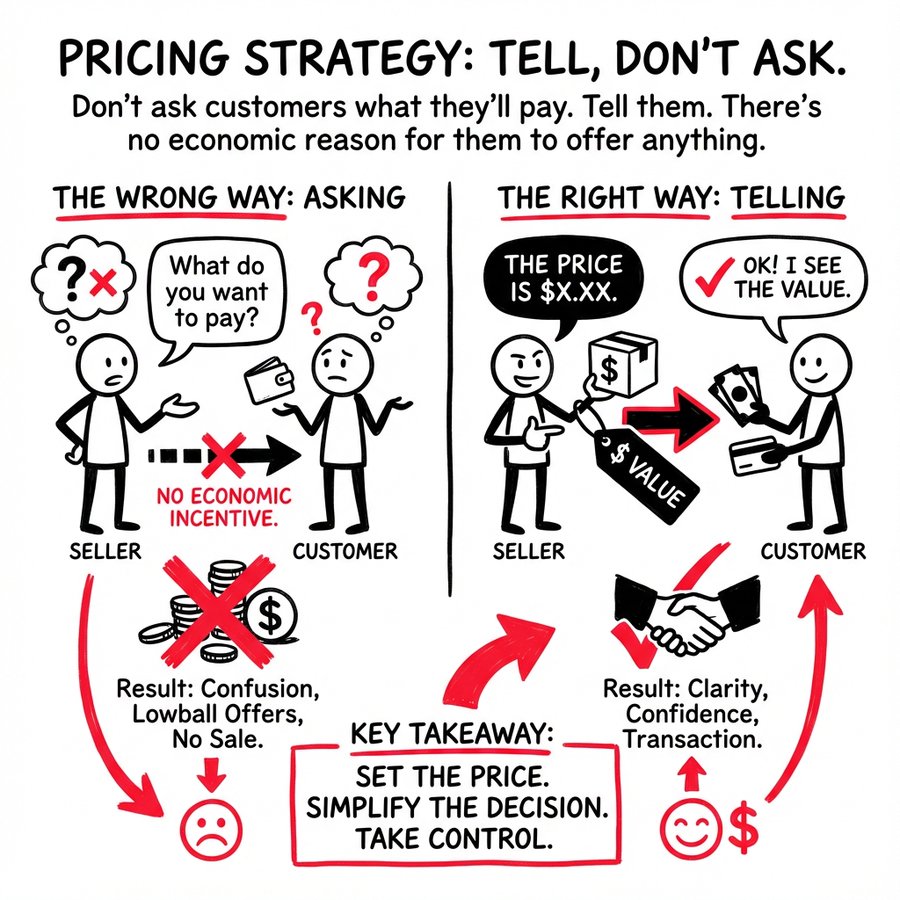
“Your Pricing Strategy Should Be Tell Not Ask
Don’t ask customers what they’ll pay. Tell them. There’s no economic reason for them to offer anything but a lowball figure.”
Ash Maurya (@ashmaurya)
I am in full agreement on this. It’s only by making a clear offer that you are prepared to honor, and that risks a “no,” that you can get real information about customer willingness to pay.
+ + +
I heard the bells on Christmas Day
Their old, familiar carols play,
And wild and sweet
The words repeat
Of peace on earth, good-will to men![…]
And in despair I bowed my head;
“There is no peace on earth,” I said;
“For hate is strong,
And mocks the song
Of peace on earth, good-will to men!”Then pealed the bells more loud and deep:
“God is not dead, nor doth He sleep;
The Wrong shall fail,
The Right prevail,
With peace on earth, good-will to men.”Henry Wadsworth Longfellow, “Christmas Bells,” written on Christmas Day 1863
A clear-eyed view of ourselves and of the world sees wonders, faults, and problems. Such is the nature of free will. But in that same nature is our opportunity to improve ourselves and the world. I used this as the closing quote for Merry Christmas 2025.
+ + +
“We wait for the Skynet moment while we are actually being quietly denied a mortgage by a black box model trained on decades of inherited exclusion.”
Colin W. P. Lewis “The Skynet Fallacy“
+ + +
“Nothing astonishes men so much as common-sense and plain dealing. All great actions have been simple.”
Ralph Waldo Emerson, “Art“
+ + +
Vigorous writing is concise. A sentence should contain no unnecessary words, a paragraph no unnecessary sentences, for the same reason that a drawing should have no unnecessary lines and a machine no unnecessary parts. This requires not that the writer make all his sentences short, or that he avoid all detail and treat his subjects only in outline, but that every word tell.
William Strunk, Jr. in “The Elements of Style” (1918)
+ + +
“Power worship blurs political judgement because it leads, almost unavoidably, to the belief that present trends will continue. Whoever is winning at the moment will always seem to be invincible. If the Japanese have conquered south Asia, then they will keep south Asia for ever, if the Germans have captured Tobruk, they will infallibly capture Cairo; if the Russians are in Berlin, it will not be long before they are in London: and so on. This habit of mind leads also to the belief that things will happen more quickly, completely, and catastrophically than they ever do in practice.”
George Orwell in “Second Thoughts on James Burnham” (May 1946)
+ + +
“Of the five senses, common-sense and a sense of humor are the rarest.”
“Poor Richard Junior’s Philosophy,” The Saturday Evening Post, 1906, George Horace Lorimer, editor
+ + +
“Wonder is the beginning of awe, and awe is the beginning of wisdom.”
Abraham Joshua Heschel in Who Is Man? (1965)
My summary of these two paragraphs from “Who is Man?”
Awe is more than an emotion; it is a way of understanding, insight into a meaning greater than ourselves. The beginning of awe is wonder, and the beginning of wisdom is awe.
Awe is an intuition for the dignity of all things, a realization that things not only are what they are but also stand, however remotely, for something supreme. Awe is a sense for transcendence, for the reference everywhere to mystery beyond all things. It enables us to perceive in the world intimations of the divine, to sense in small things the beginning of infinite significance, to sense the ultimate in the common and the simple: to feel in the rush of the passing the stillness of the eternal. What we cannot comprehend by analysis, we become aware of in awe.
Abraham Joshua Heschel in Ch. 5. – Who Is Man? (1965)
+ + +
“The capacity for wonder has been called our most pregnant human faculty, for in it are born our art, our science, our religion. […]
And wonder grows with knowledge, provided the spirit of the learner keeps growing. […]
Yes, our sense of wonder should grow with experience and wisdom. Our universe is so vast and varied that the more we know, the more we feel remains to be known. No matter how learned we are, the field of knowledge which even the best of us can master is like an island surrounded by a limitless ocean of mystery. And the larger the island of knowledge, the longer the shore line of wonder.”
Ralph Washington Sockman (1889 – 1970) in Now to Live! (1946) Chapter “The Dog and the Manger”
h/t Gaither’s Dictionary of Scientific Quotations by Charles Gaither I like Gaither’s Dictionary because it frequently provides a citation to the original which allows me to see the quote in context and to explore for other insights in the book, article, or poem. LibQuotes is very good about providing sources. This quote reminds me of a quote I curated in February 2023 (I prefer Sockman’s “shoreline of wonder” to Wheeler’s “shore of our ignorance”):
“We live on an island surrounded by a sea of ignorance. As our island of knowledge grows, so does the shore of our ignorance.”
John Archibald Wheeler (quoted in John Horgan’s Dec-1-1992 Scientific American Article “The New Challenges” [Paywall])
+ + +
“I might as well be frank, monsieur. It would take a miracle to get you out of Casablanca, and the Germans have outlawed miracles.”
Senor Ferrari (Sidney Greenstreet) in Casablanca
+ + +
“Miracles are not contrary to nature but only contrary to what we know about nature.”
St. Augustine
+ + +
“Miracles, in the sense of phenomena we cannot explain, surround us on every hand; life itself is the miracle of miracles. Miracles in the sense of events that violate the normal course of our experience are vouched for every day.”
George Bernard Shaw “Preface to Androcles and the Lion: On the Prospects of Christianity” in chapter “Credibility of the Gospels“
+ + +
“Self-sacrifice is the real miracle out of which all the reported miracles grow.”
Ralph Waldo Emerson “Society and Solitude” Chapter: Courage
+ + +
“A man who saw a miracle would reject his eyes’ witness, if those with him saw nothing.”
Ursula K. Le Guin in “The Lathe of Heaven”