
Quotes for Entrepreneurs curated in August 2026 from a variety of sources on a theme of soliciting and responding to feedback.
Quotes for Entrepreneurs Curated In August 2026
I curate these quotes for entrepreneurs from a variety of sources and tweet them on @skmurphy about once a day where you can get them hot off the mojo wire. At the end of each month I curate them in a blog post that adds commentary and may contain a longer passage from the same source for context.
My theme for the August 2026 “Quotes for Entrepreneurs” is soliciting and responding to feedback.
+ + +
“Honest criticism is hard to take, particularly from a relative, a friend, an acquaintance or a stranger.”
Franklin P. Jones
This aphorism is also attributed to Jones: “Nothing produces such odd result as trying to get even.”
+ + +
“A Lean Canvas is not a plan. It is a list of everything you could be wrong about.
Nine boxes, all guesses, written in fifteen minutes.
The move is not to make them better guesses. It is to rank them by the cost of being wrong, then go test the one at the top.”
Ash Maurya
+ + +
“Life without industry is guilt, and industry without art is brutality: and for the words ‘good’ and ‘wicked,’ used of men, you may almost substitute the words ‘Makers’ or ‘Destroyers.'”
John Ruskin in “Lectures on Art: Delivered Before the University of Oxford in Hilary Term, 1870“
+ + +
“Some people have built-in filters that screen out the boos and amplify the hurrahs . Those are the people who never know when they’re in trouble.”
Tommy Davis, Venture Capitalist (quoted in “A kick in the seat of the pants” by Roger Von Oech)
+ + +
“Code never survives first contact with the users.”
Wally McClure (@wbm)
+ + +
“IF you shut your door to all errors truth will be shut out.
‘I HAVE lost my dewdrop,’ cries the flower to the morning sky that has lost all its stars.
What you are you do not see, what you see is your shadow.”
Three from Rabindranath Tagore in “Stray Birds“
+ + +
“The product of work isn’t only the work, it’s also the worker. Doing the work changes you; the up-close experience transforms your capabilities and even your desires. Insights and ideas emerge from that interface, and I believe the agent maestros lose a lot–too much–when they take their big step back.
I don’t merely want things done; I want to do them.”
Robin Sloan in “Fogbound“
h/t Marcin Wichary; emphasis in original. Sloan is making an important point: doing a task changes you, it gives you insights and skills that you don’t gain from just watching or delegating.
+ + +
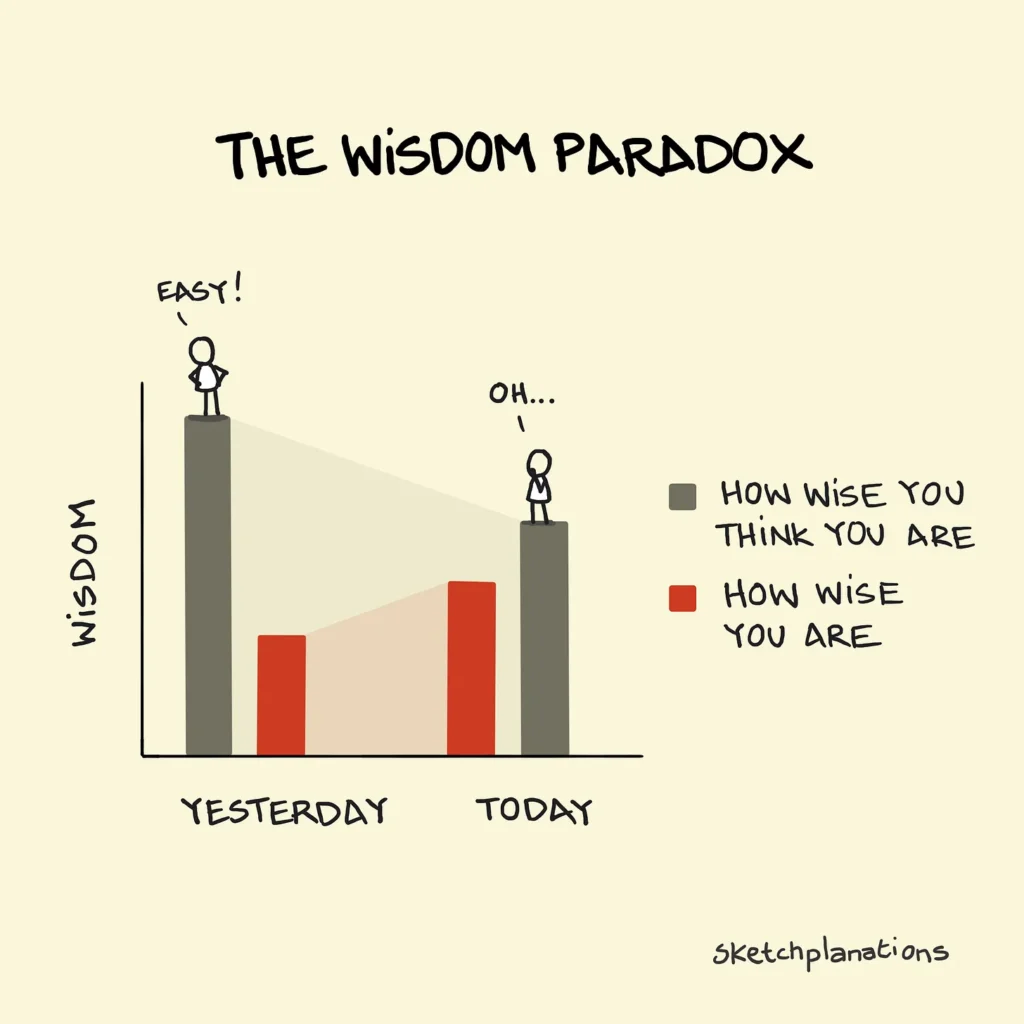
h/t Jono Hey “The Wisdom Paradox”
“Wisdom tends to grow in proportion to awareness of your ignorance. When you come to see you are not as wise today as you thought you were yesterday, you are wiser today.”
Anthony Mello in “One Minute Wisdom”
Removing old errors, including misperceptions, misunderstandings, mistaken beliefs, and false assumptions, is a key skill for entrepreneurs. Many assumptions you make when you start are incorrect.
+ + +
“Every calamity is a spur and valuable hint.”
Ralph Waldo Emerson “Fate”
A calamity is feedback of a sort if you take the time to learn from it.
+ + +
“haec quae nocent docent”
Latin proverb: Those things which hurt also teach.
It’s hard to thread the needle: you often need to iterate to tinker with and refine your approach so even if an approach does not work the first time it’s worth trying a few variations before abandoning it. On the other hand you don’t want to keep making the same mistake over and over. Persistence pays off but you have to vary your approach: most problems are combination locks so that even if you are two thirds correct you may make no progress.
I originally curated this in April 2019 and explored the concept of “retry, vary, or make a change” in July of 2012.
+ + +
While there is a lot of truth to the proverb that “There is no growth without pain,” it’s also true that there can be pain without growth. As entrepreneurs we focus on bringing change but there is a risk that we waste a customer’s time and effort, or even leave them worse off, if we are not careful.
“Take care. It is so easy to break eggs without making omelettes.”
C. S. Lewis in “Letters to Malcolm”
I originally curated this C. S. Lewis quote in May 2024
+ + +
“Strategy is a system of expedients; it is more than a mere scholarly discipline. It is the translation of knowledge to practical life, the improvement of the original leading thought in accordance with continually changing situations.”
Helmuth von Moltke the Elder, “On Strategy” (1871).
I like von Moltke’s suggestion that a strategy is not like pouring the foundation of a building and never adjusting it; instead, it should be improved “in accordance with continually changing situations,” which is also known as responding to feedback (or new realities, as the case may be). Experienced entrepreneurs learn that no plan survives contact with customer feedback and competitor responses.
+ + +
“Significant changes in human behavior can only be brought about rapidly if the people expected to change actively participate in deciding what that change will be and how it will be made.”
Herb Simon “Recent Advances in Organization Theory” (1955) in “Research Frontiers in Politics and Government”
+ + +
“Momentum grows faster than motivation.
Amateurs get ready; professionals get started.”
Mark Manson (@Markmanson) (May 19, 2026 tweet)
+ + +
“The most successful people I know don’t think of their career as a ladder. But rather, a jungle gym. They make sure that their vision is always peripheral so that they can see opportunities that come along—and swing to them. ”
Patricia Sellers in “Get Used to the Jungle Gym” (2009) [paywall]
I like this metaphor and it’s emphasis on the need to not only look up, but look around. It reminds me of a line by Francis Bacon,”All rising to great place is by a winding stair.” It’s from his 1625 essay, “Of Great Place” (1625). Guy Kawasaki riffs on this metaphor–without crediting Patricia Sellers–in “Careers are Jungle Gyms Not Ladders”
Most career advice still assumes a ladder. You start at the bottom, climb rung by rung, collect better titles, more money, and more authority, and eventually arrive somewhere called “the top.”
It’s tidy, linear, and reassuring. It suggests that progress is vertical and that success is simply a matter of climbing steadily upward. It’s also a poor description of how real careers actually unfold.
Real careers look more like jungle gyms. You climb up, move sideways, drop down, hang upside down for a while, and sometimes jump across to something new entirely. Progress isn’t measured only by elevation, but by agility, strength, and perspective. The value comes from how many dimensions you can move in, not just how high you can go. […]
The most durable careers are built by people who optimize for strength instead of height. They focus on building capability—judgment, communication, resilience, pattern recognition—because those skills travel with them no matter where they climb.
Titles expire. Strength compounds.
If you invest in learning how to adapt, collaborate, and recover from missteps, you’re not dependent on a single company or industry to validate you. You can grab a new bar when the old one disappears. […]
Pay attention to where you’re growing, where you’re coasting, and where you might need to shift direction. The goal isn’t constant ascent. The goal is to keep developing the strength and flexibility to move with confidence.”
Guy Kawasaki “Careers are Jungle Gyms Not Ladders“
+ + +
“Any attempt to manage human beings needs to take into account that our evolutionary history is weighted towards surviving in small bands of savannah-dwelling hunter-gatherers.”
Byrne Hobart in “Open Thread 195” (Aug-15-2026)
.
+ + +
“I am an enthusiast, but not a crank in the sense that I have some pet theories as to the proper construction of a flying machine. I wish to avail myself of all that is already known and then if possible add my mite to help on the future worker who will attain final success.”
Wilbur Wright in a May 20, 1899 letter to the Smithsonian Institution requesting available publications on human flight.
+ + +
“Among the well-know phenomena of group dynamics is the alacrity with which members of a cohesive in-group suppress deviational points of view by putting social pressure on any member who begins to express a view that deviates from the dominant beliefs of the group; this pressure often takes the form of urging the dissident member to remain silent if he cannot match up his own beliefs with those of the rest of the group.”
Irving Janis in “Victims of Groupthink” (1972)
It’s a tricky problem because you want your team to be cohesive and work within effective norms, but the realities of early-stage startups require a full and frank exchange of views.
+ + +
“Just calling it “feedback” doesn’t mean that it has actually fed back. To speak precisely: it hasn’t fed back until the system changes course. Up to that point, it’s merely Sensory Input.”
John Gall in Systemantics: The Systems Bible
The best feedback for early-stage startups is direct input from prospects and customers, either in conversation or email. Surveys can impose a structure that screens out feedback that might surprise you, and is therefore the most useful. However, you should only ask questions or seek feedback you are prepared to act on. Gall warns later in Systemantics that, “A system that ignores feedback has already begun the process of terminal instability.”
+ + +
“Entrepreneurs are always taking feedback, especially from their customers, bankers, workers, and sales force. Without straightforward feedback, entrepreneurs cannot make sound decisions.”
This is from a section credited to Robert Kiyosaki.
+ + +
“Information about past behavior, delivered in the present, which may or may not influence future behavior.”
Gerald Weinberg in “Quality Software Management. Vol 3. Congruent Action”
This is Weinberg’s definition of “feedback.”
+ + +
“When there are long delays in feedback loops, some sort of foresight is essential.”
Donella Meadows in “Thinking in Systems”+ + +
“If you want to create the common sense that comes from twenty years of being in the world, you need to devote twenty years to the task. You can’t assemble an equivalent collection of heuristics in less time; experience is algorithmically incompressible.”
Ted Chiang in The Lifecycle of Software Objects [online text at Subterranean Press]
In “Marcelo Rinesi: The Expertise Light Speed Barrier” Marcelo Rinesi makes much the same point about fundamental limits on acquiring expert knowledge that Chiang offers as “experience is algorithmically incompressible.”
Much of common sense is plain dealing with other people: effectiveness here flows from developing the right values early.
Entrepreneurs are resistant to peer pressure; they can tolerate being viewed as an outlier and persist in the face of many people who see them as wrong. This serves them well when bringing revolutionary ideas and systems to market, but it can mislead them when it’s a values mismatch with a community.
There is an important distinction between feedback that says, “your idea is won’t work” and “you are acting in ways that are dishonest, deceptive, manipulative, or untrustworthy.” You should understand why the person is giving you either kind of feedback, but it’s rarely a good idea to ignore the latter.
+ + +
“A lean canvas is not a business plan. It is a list of everything you are betting on, in an order you can attack.”
Ash Maurya (@ashmaurya) in an Aug-25-2026 tweet
+ + +
“I discovered that starting a business is as much an act of self-expression as it is a professional one. I found that our beliefs, energetic patterns, and our thoughts manifest themselves in our careers in ways that I couldn’t have imagined. I also realized that many of us feel the need to bring more spiritual consciousness into the workplace, so that each of us can contribute to the world in ways that are more self fulfilling and holistic.”
Riz Virk in Zen Entrepreneurship (revised edition)
I like this quote. It’s certainly a good idea to pay attention to your intuitions about people and situations, but I did not like the “business fable” format of Zen Entrepreneurship and overall found it more mystical than practical. Rizwan Virk has an excellent book, Startup Myths and Models, that is factual, practical, and insightful. He fell short of the mark on this here. I also found his composite character, Ramaswami, frankly unbelievable.
Jon Winokur wrote a great biography of James Garner called “The Garner Files: A Memoir” that does a good job of explaining how Garner relied on “luck” and intuition in his career. Winokur does into some detail about how Garner also relied on careful observation and cultivated habits that led to his “luck.”
+ + +
“The trick to viewing feedback as a gift is to be more worried about having blind spots than hearing about them.”
James Clear (@JamesClear) Dec 15, 2020 tweet
Successful founders compare notes frequently with other entrepreneurs, form advisory boards, and join a Mastermind group so that problems and blind spots are uncovered by a friendly fire before a competitor can exploit them.
+ + +
“Even the most basic CEO building blocks will feel unnatural at first. If your buddy tells you a funny story, it would feel quite weird to evaluate her performance. It would be totally unnatural to say, “Gee, I thought that story really sucked. It had potential, but you were underwhelming on the buildup and then you totally flubbed the punch line. I suggest that you go back, rework it, and present it to me again tomorrow.” Doing so would be quite bizarre, but evaluating people’s performances and constantly giving feedback is precisely what a CEO must do. If she doesn’t, the more complex motions such as writing reviews, taking away territory, handling politics, setting compensation, and firing people will be either impossible or handled rather poorly.”
Founders must set performance standards based on what customers value and hold everyone on the team, including themselves, accountable. Because everyone has blind spots, they must solicit feedback on their own performance from other team members, partners, prospects, and customers. This wider perspective can also detect team-level blind-spots. Founders must act on this feedback, or the ask will become a performative ritual. The key is to understand what customers value and to pull that assessment into day-to-day decisions and procedures to minimize potential customer dissatisfaction, which can lead to sales that don’t advance, failed trials, and customer churn.
+ + +
“The first step in evaluating feedback is sizing up who it came from.”
Austin Kleon in “Show Your Work“
+ + +
“The art of concluding from experience and observation consists in evaluating probabilities, in estimating if they are high or numerous enough to constitute proof. This type of calculation is more complicated and more difficult than one might think. It demands a great sagacity generally above the power of common people. The success of charlatans, sorcerers, and alchemists–and all those who abuse public credulity–is founded on errors in this type of calculation.”
Benjamin Franklin and Antoine Lavoisier, Rapport des commissaires chargés par le roi de l’examen du magnétisme animal (1784), as translated in “The Chain of Reason versus the Chain of Thumbs”, Bully for Brontosaurus (1991) by Stephen Jay Gould, p. 195
+ + +
“Aragorn felt a shudder run through him at the sound, a strange cold thrill; and yet it was not fear or terror that he felt: rather it was like the sudden bite of a keen air, or the slap of a cold rain that wakes an uneasy sleeper.”
J. R. R. Tolkien in “The Two Towers“
Aragorn, accompanied by Gimli and Legolas, encounters Gandalf in Fangorn Forest but does not recognize him because he believes that Gandalf did not survive the fight with the Balrog. Tolkien’s metaphors for Aragorn’s sensation of “wake up and pay attention” are apt. It’s recognition at a subconscious level that, despite his inability to articulate it, triggers a heightened sense of awareness. Stan Lee would have Spider-Man say, “my spider-sense is tingling” in situations like this. I originally curated this in May 2021 but realized an entrepreneur’s intuition will often provide a very useful form of feedback.
+ + +
“I find conversations get much more real when the glint from the sharp edge of disaster is clearly visible on the road ahead.”
Sean Murphy in “Beston Jack Abrams: Recognize and Act On The Truth.”
Inspired by Abrams’ aphorism, “To the extent it requires a review of the status quo, adversity is not all bad.” I originally curated this in March 2017. If you are on the road to disaster, change course.