
In “Every Contact Leaves a Trace” Connie Fletcher explores the mindset of practical work experience of forensic evidence technicians.
Every Contact Leaves a Trace by Connie Fletcher
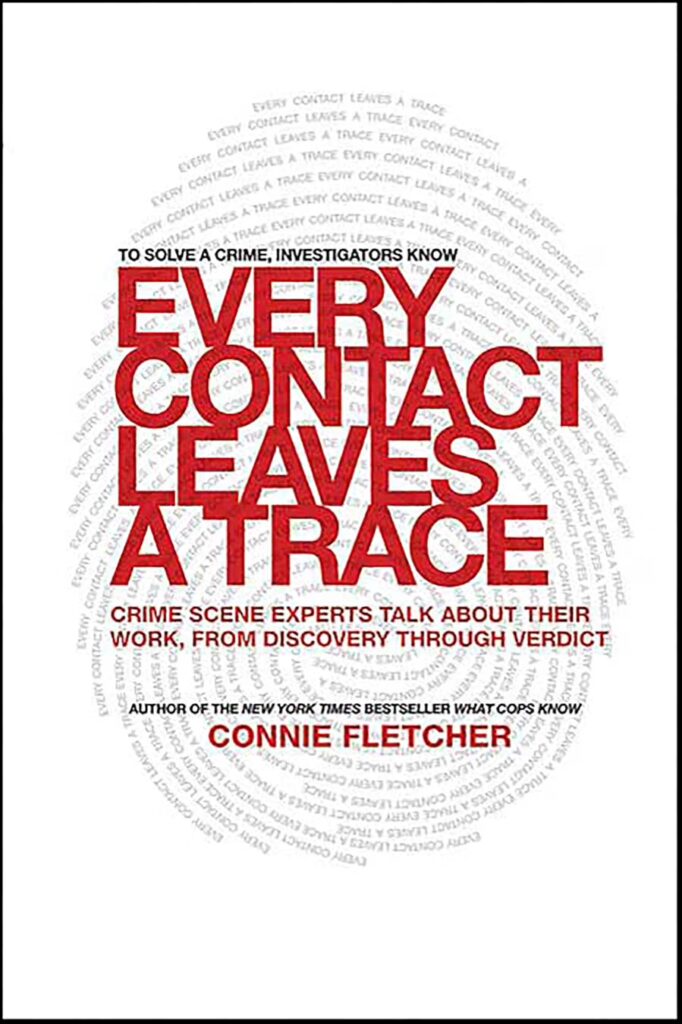 Connie Fletcher has written three other books about the police:
They all follow the same format: she interviews experts in different roles in the justice systems and allows them to offer their perspective on the realities of their job and their role in the justice system. This fourth book takes its title from a quote by a pioneer in forensic science, Edmond Locard: “Every contact leaves a trace.”
I am writing about it because I think it offers some useful insights for entrepreneurs who are in the discovery phase for their startup. I am not sure how Connie Fletcher assembles these books but she allows each individual to tell stories about their experiences and lets the reader draw their own conclusion. I think a curated list of stories from prospects and customers is one good outcome from a series of interviews for a new product.
“The forensic science world is not an easy one for an outsider to crack. How do you find and then talk with a DNA analyst buried deep within the DNA section of a lab? How do you get an evidence technician or a forensic anthropologist or a medical examiner to open up about what really goes on? How do you know who the players are? How do you know you’ve got reliable sources? How do you know you’re asking the right questions rather than woefully ignorant questions?
I work with the belief that, for a project like this, the whole world opens up if you can find the right lever. What the outsider needs, I learned in college anthropology, is a “key informant,” a reliable source within a group who puts you in contact with other reliable sources. I was lucky enough to have several key informants going into this project. I talk about these people in the acknowledgments. As I interviewed, one reliable expert would lead me to the next. Experts kept telling me, “Forensics is a pretty small world. We all know each other.”
It’s one thing for the outsider to get forensic experts to talk. It’s another challenge for the outsider to understand what they’re saying. What saved me in interviews was that forensic experts are well-versed in translating for jurors when testifying in court. And I’ve taken a professional vow to always admit ignorance, rather than pass it along to the reader.”
Connie Fletcher in “Every contact leaves a trace”
I like this quote because it documents a process that works for exploring a niche market.
DNA, Fingerprints, and Footwear
There are three things we can identify people from routinely: one is DNA, the other is fingerprints, and the third is footwear. Crime lab director. Take your shoes off and look at the bottoms. What you’ll see, in addition to the general wear pattern, are a whole bunch of unique, random scratches, marks, gouges. You’ll see them on the bottom of your shoes. These marks start to form when you start wearing your shoes, and those unique, random marks that you get are what we refer to as individual characteristics. I can take a police department with 500 police officers that all wear the same boot, and we could differentiate each pair from all of the others. Ultimately, all shoes soles develop their own random characteristics.
Footwear impressions specialist
I don’t know what I assumed but I did not realize that shoe tread wear and incidental damage turn a pair of shoes into the equivalent of a pair of fingerprints. The crime labs have digital tools to make rapid comparison between footprints and shoe treads.
Tire Tracks
Tire tracks can have the same value as footwear, just like shoes have individual characteristics. So do tires; they’re the same type of thing. Additional things can be done with tire tracks because we may be able to identify the type of vehicle that made the track. It might be a passenger car, light truck, or heavy-duty truck. That can give us a lot of information. Some tires might be particular to a certain type of vehicle. Some tires might be original equipment tires. With tires, you can trace them right back to the manufacturer and go from there.
Trace analyst
Another interesting fact I had not appreciated, the base tread pattern can be used to identify the tire and the likely make and model of the vehicle, but driving also turns tire treads into the equivalent of fingerprints.
Glass
“If you break a window with a hammer, a large percentage of that glass goes in the same direction as the hammer, but a very significant amount of it goes back the other direction. Now these are minuscule pieces; they’re tiny. They go back on the person who broke the window. Glass, to a certain extent, is elastic and it springs back.
So the person breaking the window can have these tiny shards all over them, on their hair, on every part of them. So we take a suspect’s clothing, shake it down, and look for these things. Then we go back, take a sample from the window, and compare that to the glass found on them to see if that glass has the same physical properties and optical properties as that found on the suspect.”
Glass specialist.
I’ve never broken a window so I did not realize that miniscule pieces of glass are sprayed backward.
The job is probably dripping into my private life.
The job is probably dripping into my private life. I was washing my hands at a friend’s house one time, and she said, “What are you doing? Surgery?” I just got into the habit, you know, scrubbing under the fingernails, really, really scrubbing where I was doing DNA casework, and I was washing my hands many times a day. And when I left the bench for the management position, I can tell you it felt totally weird not to have gloves on all the time.
DNA specialist.
I suppose computer programmers might feel it strange not to be typing on a keyboard. I wonder if surgeons and dentists feel the same way about gloves. There must be a number of professions who value voice-input systems because they cannot type: pathologist doing autopsies, welders, phlebotomists, and astronauts to name a few.
The scintillating aspects of watching paint dry
“Crime lab work often has all the scintillating aspects of watching paint dry. It is a very detailed job. You’re doing the same activities over and over again. There are not a lot of gross motor skills involved. People shouldn’t see this as a glamorous job or as an active job. I want to reduce people’s expectations. On the other hand, I’ve been doing this for about 30 years. I’ve never once regretted that I chose to go into this field. I characterize it as routine but rarely boring. Well, you’re not going to be doing things. Those gross motor running round things. When you make that identification as a fingerprint examiner, when you make the DNA match for the DNA folks, it’s a yes kind of moment.”
Latent print examiner
There must be many painstaking professions that require fine motor skills: jewelers, surgeons, dentists, watch repairmen, and tattoo artists to name a few.
The nutshell is testimony
“The climax to your work is testifying in court. To put it plain and simple, anybody can come in and learn how to process evidence. Not everybody can do the comparisons and identification, but the end result is testifying in court. If you can’t testify in court, you’re basically useless. It all comes down to the nutshell, and the nutshell is testimony.”
Latent Print Specialist.
Unlike many other detailed-oriented professions where the final result may only be a written report, the forensic technicians must not only write detailed reports but also be prepared to testify in an adversary process.
Related Blog Posts
- Matthew McConaughey offers a playbook in “Greenlights”
- Mike Maples on Pattern Breakers
- Seth Godin: This is Strategy, Make Better Plans
Note on Alternate Titles: This book was also published as Crime scene: inside the world of real CSI and Real Crime Scene investigation. It’s also available at the Internet Archive.
Image Credit: book cover.