
One of our key activities for 2026, located somewhere between a New Year’s Resolution and a strategy, is an effort to identify our building blocks.
Building Blocks: Our 2026 Theme
Still crafting our plans for how to define, capture, verify, refine, remix, and assemble them into larger structures. In 2026, our theme is simple: building blocks.
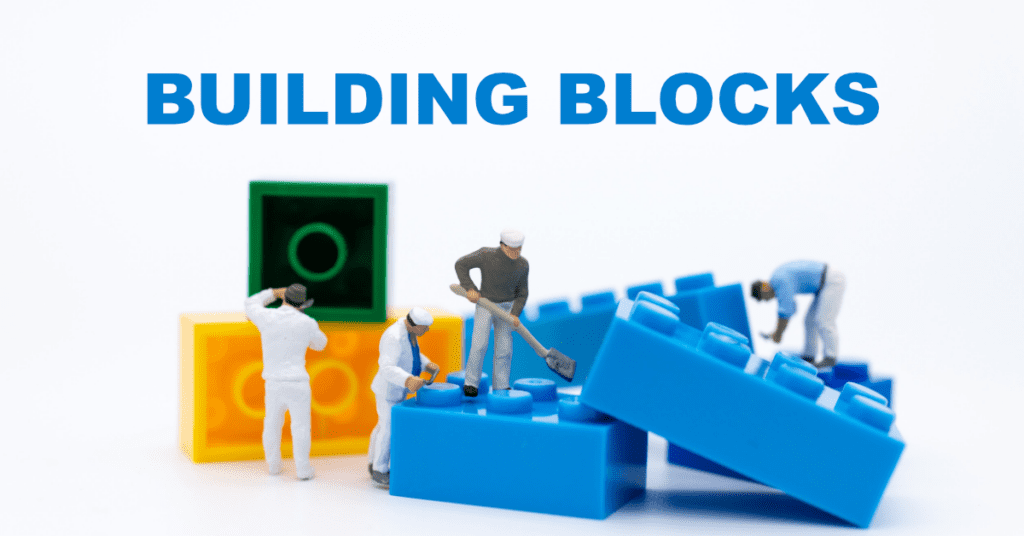
Why Building Blocks?
- Create Reusable Assets
- Stay Flexible as Reality Changes
- Make Progress Visible
- Provide a Simple Mental Model
1. Create Reusable Assets
Every effort should produce something that can be used again. Instead of one-off work, we focus on assets that compound over time:
- A blog post becomes a talk, then a workshop, then a guide
- A customer conversation becomes a script, then a playbook
- A prototype becomes a module in a larger system
This shift—from output to reusable asset—dramatically increases leverage.
2. Stay Flexible as Reality Changes
Startups operate in uncertain environments. Assumptions change. Markets shift. Customers surprise you.
Building in blocks allows you to:
- Swap out weak components
- Recombine proven elements
- Pivot without starting over
Think LEGO, not poured concrete. Flexibility is not just a benefit—it’s a survival strategy. This ability to remix allows some building blocks to incorporate other blocks in a hierarchy in the same way that building or software can be composed out of a mix of standard components and custom work.
3. Make Progress Visible
Large goals can obscure real progress. Building blocks make it tangible.
Instead of saying, “We’re still working on it,” we can point to:
- A validated FAQ
- A working prototype
- A repeatable sales conversation
- A refined workshop agenda
Each block is evidence. Each block builds confidence—with your team, your customers, and your partners.
4. Provide a Simple Mental Model
Building blocks give teams a shared way to think:
What is a meaningful unit of value we can create, test, and improve?
This question keeps us grounded. It encourages action over abstraction and learning over speculation.
What Do Building Blocks Look Like?
They take many forms:
- Content serves as foundational building blocks that can be reused, refined, and expanded over time.
- Structured conversations: scripts, guidelines, and agendas for live, interactive events that spark shared learning.
- Self-service tools allow entrepreneurs to engage, diagnose, and learn on their own terms: FAQs, self-service quizzes and calculators, and static and interactive diagrams.
- Models and configurators: models enable understanding and prediction, configurators assemble building blocks into larger solutions.
- Strategies and Pattern Language codify experience and enable tactics to be composed into coherent projects.
1. Content as Building Blocks
Content serves as foundational building blocks that can be reused, refined, and expanded over time. Articles, blog posts, audio, video, and chalk talks capture insights in modular form, allowing them to be repurposed into workshops, guides, and “working capital.” Instead of one-off efforts, each piece becomes a reusable asset that compounds in value. This approach enables continuous learning, faster iteration, and consistent messaging while reducing the effort required to create new materials from scratch.
2. Structured Conversations
We develop scripts, guidelines, and agendas for live, interactive events that spark shared learning. These extend into two- and three-handed formats—Q&A sessions, interviews, and podcasts—that start scripted, go live, and improve with each iteration.
3. Self-Service Tools
We invest in self-help assets:
- FAQs
- Self-service quizzes and calculators
- Static and interactive diagrams
These allow entrepreneurs to engage, diagnose, and learn on their own terms.
4. Models and Configurators
We build models that help entrepreneurs understand and predict how systems evolve. Configurators allow teams to assemble proven components into larger solutions—reducing guesswork and increasing reliability.
5. Strategies and Pattern Language
Finally, we codify experience into strategies and pattern languages that compose tactical moves into coherent projects. These patterns help teams move faster because they don’t have to start from scratch.
Key Aspects of Building Blocks
 For a service firm such as ours, we view building blocks as well understood tools deployed in the context of refined techniques and methods. We believe they have the following attributes:
- Where to use: situation, problem or need where they can be applied.
- Inputs: what you need to get started.
- Process: steps, checklist, procedure definition.
- Outputs: what outcomes or results you can reliably deliver.
- Where contraindicated: where they are unlikely to work, often because one or more setup steps or precursor conditions don’t hold.
- Known side effects and shortcomings: what else may follow from using this building block.
As I indicated earlier, they can be defined in a blog post, be part of a talk, guide an exercise in a workshop, or be part of a book or larger guide. Building blocks allow you to start small, validate quickly, and assemble toward something larger. This definition closely aligns with patterns or rules in a pattern language.
Our Focus on Building Block Assets
In 2026, we will focus on building blocks: starting small, validating quickly, and assembling toward larger systems. This approach creates reusable assets that compound, keeps teams flexible as conditions change, and makes progress visible through tangible outputs. It also provides a simple mental model centered on delivering and testing meaningful units of value. Building blocks take many forms, including content, structured conversations, self-service tools, and models or configurators. Each is designed to accelerate learning, reuse proven elements, reduce risk, and enable scalable growth.
“To base thought only on speech is to try nailing whispers to the wall. Writing freezes thought and offers it up for inspection.”
Jack Rosenthal
Related Blog Posts
- 40 Tips for B2B Customer Development Interviews
- Startup Viability Toolkit: 6 Viability Worksheets to Test and Validate Your Business Idea
- A Simple Sales Schema
- Articles, Ideas, and Books That Made Me a Better Entrepreneur
- Managing Change in an Organization: An Incomplete Resource List
- Checklist Blog Category
- “Rules of Thumb” Blog Category