
A learning mindset allows founders to explore the unknown, persevere through setbacks, and gain traction.
Lean, Agile, and Agility are All About a Learning Mindset
When I talk to startup founders, I often hear the same three buzzwords: Lean, Agile, and Agility. But too often, these words get reduced to process checklists or rituals like stand-ups, burn-down charts, MVPs, or retrospectives. The why behind them can get lost
What I’ve learned from working with hundreds of early-stage teams is that the common thread in all of these approaches is learning. Successful startups are learning organizations. Agility is the ability to adapt: it requires a deep commitment to learning.
Lean Is About Learning Fast, Not Just Spending Less
Lean isn’t about cutting corners or starving your startup. It’s about understanding what your customer needs and values and avoiding the waste of time and energy spent building the wrong features, or worse, the wrong product.
I encourage founders to approach their startups like scientists. Start with a hypothesis, design the smallest test possible, and see what reality tells you. If you are not learning something new every week, you’re just staying busy, not making progress.
Don’t measure progress by what you’ve built; measure it by what you’ve learned from customers adopting your product. A learning mindset enables you to listen calmly as they criticize what you have put in their hands, or are proposing that they use, telling yourself all the while, “That’s interesting! I never looked at it that way!” You can still ask probing questions, but your goal is to understand, not win the argument or demonstrate how smart you are.
“The ability to learn faster than your competitors may be the only sustainable competitive advantage.
The best learning takes place in teams that accept that the whole is larger than the sum of the parts, that there is a good that transcends the individual.”
Arie P. de Geus in “Planning as Learning” in HBR March-April 1988
Agile Isn’t About the Process—It’s About Responding to Reality
Agile methods were developed to manage uncertainty. As a founder, you must navigate a maze of unknowns, including customer needs, product feasibility and desirability, and business profitability. You will often need to act as a pioneer, tackling a new challenge for the first time. You are unlikely to succeed if you rigidly follow the plan you crafted at the start, because that was when you had the least amount of good information. If you ignore new information because you don’t want to admit your ignorance, you are being stubborn. Agile is not a lack of perseverance; it’s recognizing the uncertainty inherent in the original plan and adjusting course based on new information.
I advise teams to run short, focused experiments. Why? Because they are in effect exploring a dark swamp at night and need to tread cautiously by interviewing a few potential customers, building a simple prototype, and asking customers to run a short pilot. Next, they must observe how their customers use the prototype, debrief with each customer, and reflect as a team on what they have learned and how their understanding has changed. Determine the best next step that’s available to you. You can solicit feedback, but you have to ask the difficult questions and do the hard thinking. It has to be part of how your team works every day.
A Culture that Values Curiosity Is Agile
Agility isn’t a process you adopt; it’s a shared capability you build. It starts with curiosity about what you don’t know. Successful founders ask questions like:
- What’s the real problem we’re solving?
- Why hasn’t this been solved already?
- What’s the smallest thing we can try to find out more?
When you and your team build the habit of asking good questions, running small experiments, and learning deliberately, you become resilient. You learn to adapt, persevering beyond setbacks to gain traction.
Startups Succeed by Learning Faster than Their Competitors
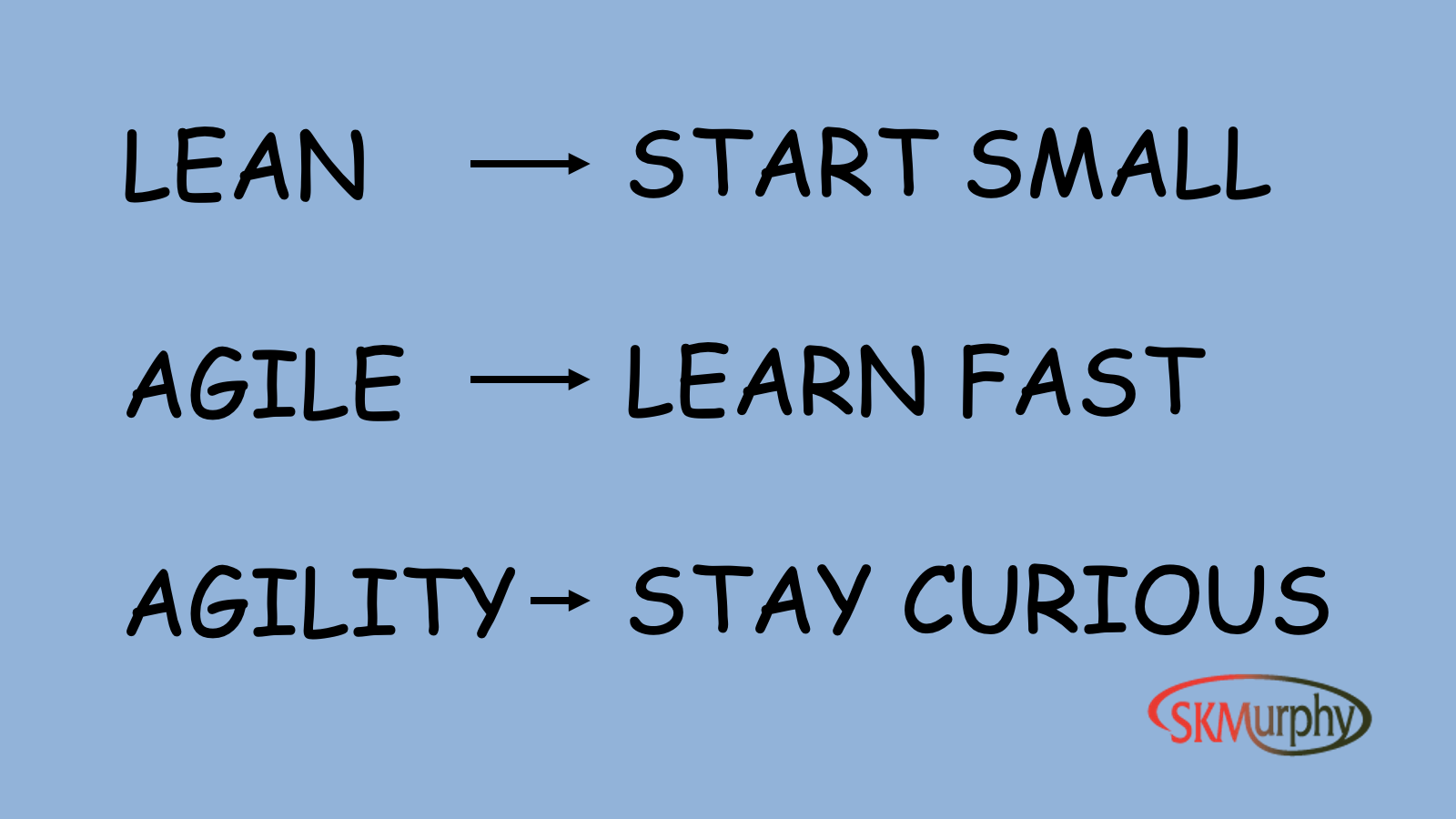
Start small. Learn fast. Stay curious.
This mindset will take you further than any playbook or rituals.
Uncertainty is the norm in the early days of a startup. Attacking it with curiosity and trial and error enables learning that reduces your uncertainty. The faster you can learn, the faster you can make better decisions that achieve better outcomes.
Startups don’t die from moving too slowly; they are supplanted by competitors who learn faster. Focus on the learning, and agility will follow.
“Expertise is what you know.
Humility is knowing what you don’t know.
Curiosity is how much you want to learn.
In a changing world, expertise quickly becomes obsolete without humility and curiosity.”
Adam Grant
Related Blog Posts
- Planning and Reflection Markets continually evolve, forcing each firm to run it’s own “Red Queen Race,” running faster and faster (or learning more and more) just to maintain market share. But action without planning and reflection is rarely effective.
- Startups Where ‘We Are All In This Together’ Learn Faster
- Customer Care: I think there has to be an ongoing, intense curiosity and care on the part of everyone in the startup who touches the customer about how to create value or how to remove things that are limiting or restricting the value customers will get from the product.
- Appreciate Why Prospects Say “Your Baby Is Ugly” When a prospect criticizes your product, or your suggestion for a solution, don’t react as if they said, “Your baby is ugly.” Appreciate their candor, make sure you understand their need, and probe for what’s wrong or needs improvement in your offering.
- Best Way to Get Feedback from Early Customers is a Conversation
- Focus on Your Prospect’s Pain, Not The Brilliance Of Your Product Idea
- Lee Carter on the Value of Direct Observation
- I Don’t Understand, We Won the Argument, Why Didn’t We Win the Sale?