
A collection of quotes for entrepreneurs curated in January 2026 around a theme of taking responsibility.
Quotes for Entrepreneurs Curated in January 2026
I curate these quotes for entrepreneurs from a variety of sources and tweet them on @skmurphy about once a day where you can get them hot off the mojo wire. At the end of each month I curate them in a blog post that adds commentary and may contain a longer passage from the same source for context.
My theme for this month’s “Quotes for Entrepreneurs” is taking responsibility.
+ + +
“I am responsible for taking action, asking questions, getting answers, and making decisions. I won’t wait for someone to tell me. If I need to know, I’m responsible for asking. I have no right to be offended that I didn’t ’get this sooner.’ If I’m doing something others should know about, I’m responsible for telling them.”
+ + +
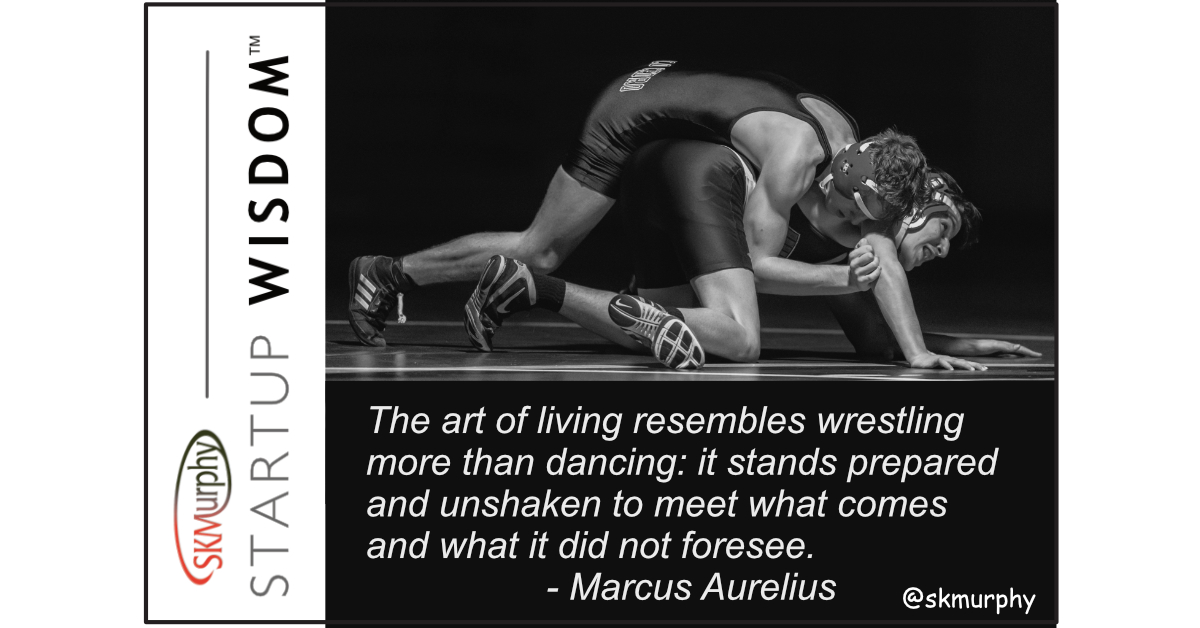
“The art of living resembles wrestling more than dancing: it stands prepared and unshaken to meet what comes and what it did not foresee.”
Marcus Aurelius in Meditations bk. 7, sect. 61.
Entrepreneurship requires you to be equally comfortable dancing or wrestling. I used this as aa closing quote for “Shifting from Specialist to Founder.”
+ + +
“It may seem difficult at first, but everything is difficult at first.”
Miyamoto Musashi in “Book of Five Rings” (Victor Harris translation)
More context:
“It is not difficult to wield a sword in one hand; the Way to learn this is to train with two long swords, one in each hand. It will seem difficult at first, but everything is difficult at first. Bows are difficult to draw, halberds are difficult to wield; as you become accustomed to the bow so your pull will become stronger. When you become used to wielding the long sword, you will gain the power of the Way and wield the sword well.”
Miyamoto Musashi in “Book of Five Rings” (Victor Harris translation)
If you take responsibility for mastering your craft you invest the effort in practice of sound methods and tactics.
+ + +
“The hero goes beyond the borders of the known world and returns with new knowledge or wealth.
The hero takes the initiative to solve an ambiguous problem.”
James Bach in “Enough about process: what we need are heroes” (IEEE Software March 1995)
I initially used this in Joe Rogan: Be the Hero of Your Own Movie.
+ + +
“To stand up straight with your shoulders back is to accept the terrible responsibility of life, with eyes wide open. It means deciding to voluntarily transform the chaos of potential into the realities of habitable order. It means adopting the burden of self-conscious vulnerability, and accepting the end of the unconscious paradise of childhood, where finitude and mortality are only dimly comprehended. It means willingly undertaking the sacrifices necessary to generate a productive and meaningful reality.”
Jordan B. Peterson, 12 Rules for Life: An Antidote to Chaos
+ + +
“Solo is lonely. But at least the arguments are shorter.
Unpopular opinion: most co-founder relationships make things worse.
Two people. Two visions. Two egos. Endless ‘alignment’ meetings.”George Pu (@TheGeorgePu) in a Jan-2-2026 tweet
The ability to find effective compromises with a cofounder is a good marker for founders who can compromise and collaborate with customers. This avoids the following inner dialog after a customer call: “I don’t understand I won the argument, how come they didn’t buy?”
+ + +
“I think the majority of society problems are all downstream of housing affordability. The median age of first-time home buyers went from 29 in 1981 to 40 today. But the shock this causes is so much deeper than housing. When young people are shut out of the life-defining step of having their own place, they’re less likely to get married, less likely to have kids, have worse mental health, and – my theory – more likely to have extreme political views, because when you don’t feel financially invested in your community you’re less likely to care about the consequences of bad policy.
Every economic issue is complex, but this one seems pretty straight forward: we should build more homes. Millions of them, as fast as we can. It’s the biggest opportunity to make the biggest positive impact on society.”
Morgan Housel “A Few Things I’m Pretty Sure About”
This is certainly a core problem in Silicon Valley. Incumbent homeowners benefit from rising housing prices and no one seems to be taking responsibility for the impact.
+ + +
“Change your opinions, keep to your principles; change your leaves, keep intact your roots.”
Victor Hugo in “Intellectual Autobiography” translated by Lorenzo O’Rourke (1907)
I curated this originally in March 2013 but thought it was a good fit for this month’s theme of taking responsibility.
+ + +
“The most expensive sentence in business and life is some variation of: “Let’s not talk about that right now,” because despite how it may feel, postponing truth only makes reality worse.”
Brent Beshore in “Permanent Equity 2025 Letter“
+ + +
“RESPONSIBILITY, n. A detachable burden easily shifted to the shoulders of God, Fate, Fortune, Luck or one’s neighbor. In the days of astrology it was customary to unload it upon a star.”
Ambrose Bierce, The Devil’s Dictionary (1911).
+ + +
“I can see myself, I can feel
That just the slightest bit of finesse
Might have made a little less mess
But it was what it was”
R.E.M “Discoverer”
Positive progress as 2026 begins but also two setbacks I could have avoided with more empathy. I am losing my deft touch…or I lost it a while ago and just now realized it. I have not been as diligent about meditating every morning in the last two weeks, that may be a contributing factor.
+ + +
“A good lifestyle is one that leads to having grandchildren. […] People are more likely to have grandchildren if they get married and start having children in their early twenties. That means that you cannot spend your twenties accumulating school credentials and sex partners. You cannot wait until you have sufficient income to buy whatever you want. As a society, we should de-emphasize higher education, sexual exploration, and materialism.”
Arnold Kling in “My Communist Vision“
I think Kling is espousing Communitarianism or responsibility at a local community level (see also https://plato.stanford.edu/entries/communitarianism/index.html), not Communism.
+ + +
“I believe that we all have a responsibility to give back. No one becomes successful without lots of hard work, support from others, and a little luck. Giving back creates a virtuous cycle that makes everyone more successful.”
Ron Conway in a 2016 interview with Alexandre Mars
+ + +
“Success on any major scale requires you to accept responsibility. In the final analysis, the one quality that all successful people have is the ability to take on responsibility.”
Michael Korda in Success! (1977)
+ + +
“Entrepreneurs are risk takers, willing to roll the dice with their money or reputation on the line in support of an idea or enterprise. They willingly assume responsibility for the success or failure of a venture and are answerable for all its facets.”
Victor Kiam
+ + +
“Responsibility is always about concrete action.”
Frank-Walter Steinmeier in “Review 2014: A Fresh Look at German Foreign Policy“
More context below. I think this is an important point for founders, answers to founder responsibility questions cannot be found in an operating manual. They require judgement, and judgement improves with consultation with those affected and a careful review of the actual results compared to what was expected.
“These review results take stock of Germany’s responsibility. There is never an operating manual for this responsibility. On the contrary, responsibility is always about concrete action. The responsibility question arises in situations that are never just black or white, and when taking decisions that are never just right or wrong. There were quite a few decisions like these in the past year.”
Frank-Walter Steinmeier in “Review 2014: A Fresh Look at German Foreign Policy“
+ + +
“And a step backward, after making a wrong turn, is a step in the right direction.”
Kurt Vonnegut in Player Piano (1952)
It’s not always possible to backtrack, but retracing your steps when you have ended up on the wrong path is a critical aspect of leadership. Some decisions are like a single move in chess, where you can keep your hand on the piece and see how it looks in context. But most are not so easily reversed and come at a cost: time, money, effort, and perhaps even lost trust.
+ + +
“Action springs not from thought, but from a readiness for responsibility.”
Dietrich Bonhoeffer in Letters and Papers from Prison
I used this in “Three Advantages of Younger Entrepreneurs in B2B Startups” and curated it originally in March 2009. I like the way it pairs action with responsibility.
+ + +
“The revolutions that matter are tool-driven, not concept-driven. The telescope, the microscope, the power loom, the computer—each one’s meaning was determined not by its inventors but by its wielders.
The doomers want AI to be a concept-driven revolution—something to theorize about in safety labs and regulate into paralysis. We know it is a tool-driven revolution. And the American worker with AI in hand will discover new things to be explained.
AI is neither apocalypse nor salvation. It is a tool—and like every great tool in American history, from the cotton gin to the assembly line to the personal computer, its meaning will be determined not by those who build it in labs but by those who wield it in the field.”
Shyam Sankar is the Chief Technology Officer and Executive Vice President of Palantir Technologies.
+ + +
“Somehow it was learning how many people are full-time employed to maintain the Golden Gate Bridge that flipped something inside of me in my understanding of the entropic force civilization has to constantly fight against. Before that moment I thought–I had not applied real conscious thought–you simply build a building or anything really and then you just…have it. After that I understood everything is constantly on the brink of being lost.”
Anna Riedl in a Jan-18-2026 tweet
Riedl clarified the team maintaining the Golden Gate Bridge is “Around 200 full-time employees (engineers, iron workers, painters, mechanics, electricians, communications techs, streets/grounds workers, etc.) working as an around-the-clock team.”
+ + +
“Almost the central theme of the book is the contrast between the Hobbits (or ‘the Shire’) and the appalling destiny to which some of them are called, the terrifying discovery that the humdrum happiness of the Shire, which they had taken for granted as something normal, is in reality a sort of local and temporary accident, that its existence depends on being protected by powers which Hobbits dare not imagine, that any Hobbit may find himself forced out of the Shire and caught up into that high conflict. More strangely still, the event of that conflict between strongest things may come to depend on him, who is almost the weakest.”
C.S. Lewis, “The Gods Return to Earth” in Time and Tide (14 August 1954)
Lewis is reviewing J.R.R. Tolkien’s “The Fellowship of the Ring” (h/t Jude Dude (full quote) and Palmer Lucky (inspiration to look for full quote)). See also Chris Mooney’s “Tolkien on Homeland Defense” (Dec-4-2001) which highlights an exchange between Frodo and Gildor that would resonate with readers grappling with the implications of 9-11:
‘I cannot imagine what information could be more terrifying than your hints and warnings,’ exclaimed Frodo. ‘I knew that danger lay ahead, of course; but I did not expect to meet it in our own Shire. Can’t a hobbit walk from the Water to the River in peace?’
‘But it is not your own Shire,’ said Gildor. ‘Others dwelt here before hobbits were; and others will dwell here again when hobbits are no more. The wide world is all about you; you can fence yourselves in, but you cannot forever fence it out.’
‘I know — and yet it has always seemed so safe and familiar.’
J. R. R. Tolkien “The Fellowship of the Ring”
+ + +
Look at the Underside First: Legions of people are paid large sums to promote the positive aspects of commercially available products. Very few people earn their daily bread by pointing out malfunctions, bugs, screw-ups, design failures, side-effects and the whole sad galaxy of trade-offs and failings that are inherent in any technological artifact. To counteract this gross social imbalance, a wise designer and a wise critic will make it a matter of principle to look at the underside first.
Bruce Sterling in Viridian Design Principles (1998)
There is much more at the Viridian Design Site. In “Constructive Pessimism,” I observed that you have to be willing to acknowledge the possibility of problems and look for them to be able to prevent or at least manage them. Many entrepreneurs who are naturally optimistic make a serious mistake in discouraging pessimistic thinking instead of putting it to good use. The clever utilization of constructive pessimism is one of the keys to success.
+ + +
“I am prepared for the worst, but hope for the best.”
Benjamin Disraeli in “The Wondrous Tale of Alroy“
This reminds me of some advice Tony Hsieh offered in his book “Delivering Happiness.”
- Always be prepared for the worst possible scenario.
- Play only with what you can afford to lose.
- Make sure your bankroll is large enough for the game you’re playing and the risks you’re taking.
- Remember it’s a long term game. You will win or lose individual sessions, but it’s what happens in the long term that matters.
Tony Hsieh in his book “Delivering Happiness” in the chapter on “Poker”
I used this in Texas Hold’Em as a Model for Technology Startups.
+ + +
“What you prepare for, what you hope for, and what you expect are often three different things.”
John D. Cook (@JohnDCook)
+ + +
“Accept the terrible responsibility of life with eyes wide open.”
Jordan Peterson
+ + +
“You cannot solve a problem until you acknowledge that you have one and accept responsibility for solving it.”
Zig Ziglar
+ + +
Effectuation Manifesto
Everything starts with You with your own means, your identity, your knowledge and competencies, and your network
You don’t have to be a risk taker, each step you give is always within
Your Affordable LossThe paths you start exploring are bound only by
Your ImaginationThe paths you get to build are those that are Co-Created
with people who commit themselves to enrich and transform
the path in-the-making with their own means and goalsWelcome Surprise as an input for the transformation of the path
You don’t predict the future
You leave that for the musings of fortune tellers and economists
You make it happen using the means, choosing the paths and calibrating each step so that You Are In Control
You can learn to build the path and you can get better at itAnyone Can! You just have to start: Do It Now!
Diogo Carmo in “Manifesto for Effectual Action” (May 10, 2016)
h/t Bill Seitz
+ + +
“The first 10% of the time that you invest in finding out the underlying laws, principles, rules, methods, and techniques of successful action in any field will save you 90% of the time and effort required to achieve your goals in that area. I have found that smart people take the time to find out the rules of success in any area before they attempt to get results in that area. They do their homework in advance.”
Brian Tracy in “The 100 Laws of Business Success”
+ + +
“In times of urgent problems, you still need to make time for the important long-term vision. That’s how you accomplish big things,. You’re going to have one-off problems, but giving a seat at the table for the future is why people came to work at SpaceX”
Senior SpaceX official quoted in Reentry by Eric Berger
+ + +
“WILLINGNESS TO ASSUME FULL RESPONSIBILITY. The successful leader must be willing to assume responsibility for the mistakes and the shortcomings of his followers. If he tries to shift this responsibility, he will not remain the leader. ”
+ + +
“Democracy has always required a category: ‘good person who disagrees with me.'”
Ilana Redstone in “For Whoever Comes Looking“
This responsibility for assuming good faith, mutual respect, and a willingness to see a situation for other points of view is critical to enabling dialogue and deliberation. You have to be able to come to an agreement on the core facts, on what has happened. You may not agree on the impact of different possible approaches and may evaluate potential outcomes using different metrics. Many seem to have lost the willingness, or perhaps even the ability, to engage in dialogue and deliberation.
h/t Arnold Kling who fears that “humans desire the moral license to hate other groups of humans.” I think this is certainly true for at least some humans and reminds me of Immanuel Kant’s belief, “Out of the crooked timber of humanity, no straight thing was ever made.” We are all flawed and need to work against our shortcomings and weaknesses as best we can.
+ + +
“Organization is the ability to turn chaos into order. You can organize time, space, and work. You cannot organized people, only their work. Innovation turns order into right action. While organization is interested in efficiency, innovation is concerned with effectiveness.”
Michael Gerber in “The Power Point” (1991)
It’s also highlighted in “5 Essential Skills.” I found this while tracing the author of the quote: “The five essential entrepreneurial skills for success are concentration, discrimination, organization, innovation and communication.” It is often attributed to Harold Geneen or Michael Faraday. My conclusion is that Peter Kauffman condensed the key elements of chapter 2 of “Power Point,” which lists the 5 skills but never puts them into a single coherent sentence, for Poor Charlie’s Alamanack (2005), attributing them for some reason to Michael Faraday. Others looked at it and said, “that can’t be right, it sounds more like Harold Geneen.” But it’s clearly Gerber who put the five skills in that sequence in 1991.
+ + +
“The truth is that nobody has any business to destroy a social institution until he has really seen it as an historical institution. If he knows how it arose, and what purposes it was supposed to serve, he may really be able to say that they were bad purposes, that they have since become bad purposes, or that they are purposes which are no longer served. But if he simply stares at the thing as a senseless monstrosity that has somehow sprung up in his path, it is he and not the traditionalist who is suffering from an illusion.”
G. K. Chesterton in “The Thing” (chapter “The Drift from Domesticity”).
This advice is often shorthanded as “Chesterton’s Fence.” I cited a different passage from the same chapter in “Orienting, Observing, Doing Homework, and Paying Dues.”
+ + +
“Where is the fine line drawn between ‘upgrading our terms of service’ and reneging on our deal?”
+ + +
“It’s often the case that you simply don’t have all the information you’d like to have, but you still must make a decision to move forward. As a result, I spend far more time thinking about how to make being wrong cheap rather than how to avoid being wrong.
Embracing curiosity is the best technique I’ve found to reduce the cost of being wrong. If I regret being wrong about something, it’s almost always because I engaged in problem solving before exercising curiosity. I feel that curiosity is the first step of problem solving has to be an engineering value in the organizations that I lead.”
Will Larson in “Curiosity is the first step of problem solving“
+ + +
“Musk is at his best in uncharted territory. When he’s blazing a trail, there is no one better in the world at looking around the corner for what could and should come next. For his employees, Musk removes barriers and constraints, encouraging them to expand their minds for what is possible, to free their thinking and search for unbounded solutions to engineering problems. It has worked astoundingly well at SpaceX.”
Eric Berger in Reentry
+ + +
“None of us have a real understanding of where we are heading. I don’t. I have senses about it. […] But decisions don’t wait, investment decisions or personal decisions and prioritization don’t wait for that picture to be clarified. You have to make them when you have to make them. So you take your shots and clean up the bad ones later.
And try not to get too depressed in the part of the journey, because there’s a professional responsibility. If you are depressed, you can’t motivate your staff to extraordinary measures. So you have to keep your own spirits up even though you well understand that you don’t know what you’re doing.”
Andrew Grove quoted in “Andy Grove Tells The Truth About What Great Leaders Do” by Bob Sutton (March 11, 2007)
Sutton observes later in his post: “A paradox that leaders face: they need to continue doubting what they have done privately; but if they express too much public doubt, then people lose confidence.”
+ + +
“Power is duty; freedom is responsibility.”
Marie von Ebner-Eschenbach
+ + +
“It’s not the load that breaks you down, it’s the way that you carry it.”
Lena Horne
+ + +
“Never allow a person to tell you no who doesn’t have the power to say yes.”
Eleanor Roosevelt