
The value pyramid model offers a pricing paradigm, a way to reduce customer risk, validate demand, and grow revenue in step with customer urgency.
The Value Pyramid as a Way to Structure and Define Your Offerings
For entrepreneurs, the value pyramid is not just a pricing model—it’s a way to reduce customer risk, validate demand, and grow revenue in step with customer urgency. It mirrors how buyers learn, decide, and commit, especially in early-stage and B2B markets.
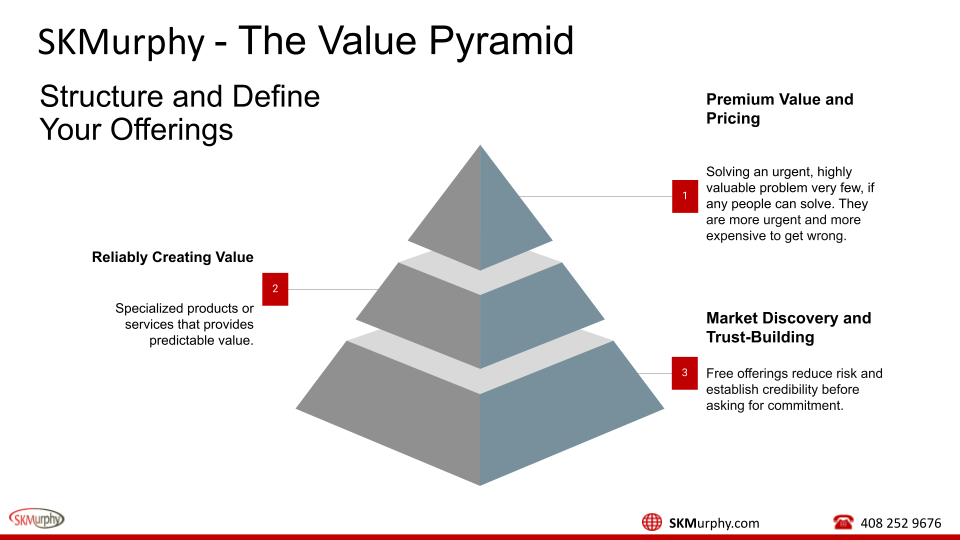
The Value Pyramid Matches How Customers Buy
Entrepreneurs often try to sell the “big solution” too early. The value pyramid works because it aligns with customer readiness:
- At the bottom, customers are curious or problem-aware
- In the middle, they are actively evaluating options
- At the top, they face an urgent decision or risk
Each tier answers a different question the customer is asking.
The Base: Learning, Trust, and Market Discovery
For entrepreneurs, the base of the pyramid is not about revenue—it’s about awareness.
Typical offerings:
- Blog posts, guides, webinars, podcasts
- Checklists, templates, diagnostic tools
- Free workshops or office hours
What founders gain:
- Evidence of real customer problems
- Language customers use to describe pain
- Early proof of credibility and relevance
- A low-risk way for customers to say “yes”
This tier fuels customer discovery, not just lead generation. At this stage, you solve a low-urgency, low-impact problem.
The Middle: Validation and Repeatability
The middle tier is where entrepreneurs test whether they can reliably create value, not just attention.
Typical offerings:
- Implementation playbooks or starter kits
- Jumpstart offerings
What founders learn:
- Which problems customers will pay to solve
- What outcomes matter most
- Where customers get stuck
- What can be standardized vs. customized
Revenue here is important but insight is even more valuable. There may be plenty of alternatives to our product or services. Usually price sensitivity is high but replacing you might be painful.
The Top: Urgency, Impact, and Premium Pricing
The top of the pyramid is where entrepreneurs solve urgent, high-consequence problems.
Typical offerings:
- 1:1 advisory or fractional roles
- Custom implementations
- Retainers or ongoing partnerships
Why this works:
- Customers are paying to reduce risk or accelerate results
- Decisions are tied to revenue, deadlines, or reputation
- Price sensitivity drops when delay is expensive
For many entrepreneurs, this tier funds the business while lower tiers feed learning and pipeline. At this tier you have moved from commodity to irreplaceable and top of mind.
Why the Value Pyramid Is Especially Powerful for Startups
It reduces founder risk
You don’t need to bet everything on a single “big launch.”
It supports bootstrapping
Free and mid-tier offerings generate insight before heavy investment.
It creates natural upsell paths
Customers move up when the cost of inaction rises.
It prevents premature scaling
You learn what truly matters before building infrastructure.
Why So Many Smart People Stay Undervalued
Most professionals market themselves like tools:
“I can code.”
“I can write.”
“I can design.”
“I can advise.”
That puts the burden on the customer to figure out what problem you should be applied to.
When that happens, buyers naturally assign you:
- Low-priority work
- Cleanup tasks
- “Nice-to-have” initiatives
That’s not a talent problem. It’s a positioning problem.
The Founder Mindset Shift
The value pyramid encourages entrepreneurs to stop asking:
“How do I sell more?”
And start asking:
“What problem does my customer face next, and how can I earn their trust to help them progress?”
Each tier exists to help customers make better decisions, not to trap them in a funnel.
How to Move Up the Value Pyramid
If you want to earn more, don’t ask for a higher rate.
Instead:
- Identify a more urgent, more consequential problem
- Tie your offering to a decision, risk, or inflection point
- Take responsibility for defining what matters now
A value pyramid works because customers ascend as their problems become more urgent and more expensive to get wrong.
You’re not pushing people upward.
You’re meeting them where they are—and being ready when they need more.
That’s what makes it ethical, scalable, and effective for founders, consultants, and experts building durable businesses.
The Fundamental Shift
Don’t say:
“I have skills—what do you want me to do?”
Say:
“Here’s the problem that’s costing you time, money, or momentum right now.
I’ve seen this before.
I can help you resolve it.”
That single shift—owning the problem instead of selling the tool—is what separates:
- Entrepreneurs capped at a comfortable income
- From those trusted at moments that truly matter
A tiered business model (like a value pyramid) offers free, valuable content (e.g., webinars, guides) at the base, leading to increasingly specialized paid products/services (courses, coaching, memberships) at higher tiers. It’s a strategy where the free offering acts as a hook to build trust and demonstrate expertise, guiding customers up the pyramid to premium, high-value, paid solutions, with the goal of generating revenue through genuine product sales, not recruitment.
In Short
For entrepreneurs, the value pyramid:
- Aligns offerings with customer urgency
- Supports discovery-driven growth
- Enables premium pricing without hype
- Builds trust before asking for commitment
It’s not about climbing the pyramid fast.
It’s about earning the right to be at the top.
Related Blog Posts
- 3D Negotiation: Pricing for Early Customers
- Your Pricing Model is a Key Lever for Profitability
- Q: How To Pull The Trigger On A Pricing Model
- Price, Value, and Your Prospect’s Perception of Risk
- Negotiate the Level of Reference in Parallel with Price and Others Terms and Conditions
- Carl Angotti on “How to Decide How Much to Charge for Your Services”