
A collection of quotes for entrepreneurs curated in July 2026 around theme of artificial intelligence.
Quotes for Entrepreneurs Curated in July 2026
I curate these quotes for entrepreneurs from a variety of sources and tweet them on @skmurphy about once a day where you can get them hot off the mojo wire. At the end of each month I curate them in a blog post that adds commentary and may contain a longer passage from the same source for context.
My theme for this month’s “Quotes for Entrepreneurs” is artificial intelligence.
+ + +
“Much to the surprise of the builders of the first digital computers, programs written for them usually did not work.”
Rodney Brooks in “Programming in Common LISP” (1985)
+ + +
“AI is a tool.
But you need to provide the goal.”
Balaji Srinivasan (blog https://balajis.com/) in a Feb-18-2026 tweet
+ + +
“What I had not realized is that extremely short exposures to a relatively simple computer program could induce powerful delusional thinking in quite normal people.”
Joseph Weizenbaum in “Computer Power and Human Reason“
Weizenbaum wrote ELIZA (original 1966 CACM article), a program that mimicked a Rogerian therapist but had no true intelligence, just some simple open ended questions triggered by keywords in user text input.For example mentioning mother or father would trigger “Tell me about your parents.” Here is a longer excerpt to put the quote in context (bold added)
“[P]eople were conversing with the computer as if it were a person who could be appropriately and usefully addressed in intimate terms. I knew of course that people form all sorts of emotional bonds to machines, for example, to musical instruments, motorcycles, and cars. And I knew from long experience that the strong emotional ties many programmers have to their computers are often formed after only short exposures to their machines. What I had not realized is that extremely short exposures to a relatively simple computer program could induce powerful delusional thinking in quite normal people. This insight led me to attach new importance to questions of the relationship between the individual and the computer, and hence to resolve to think about them.”
In the book, Weizenbaum outlines three surprises he experienced from mistaken beliefs the program generated. I think these are true today of modern LLMs:
- A number of practicing psychiatrists seriously believed the DOCTOR computer program could grow into a nearly completely automatic form of psychotherapy.
- I was startled to see how quickly and how very deeply people conversing with DOCTOR became emotionally involved with the computer and how unequivocally they anthropomorphized it.
- Another widespread, and to me surprising, reaction to the ELIZA program was the spread of a belief that it demonstrated a general solution to the problem of computer understanding of natural language.
+ + +
“If you want to become AI native you have to start small and compound wins over time. Start by automating workflows that have measurable ROI then expand from there.”
Collin McClellan, CEO at Collide.io, in a May-27-2026 tweet
+ + +
“As we come to rely on computers to mediate our understanding of the world, it is our own intelligence that flattens into artificial intelligence.”
Nicholas Carr in “The Shallows: What the Internet Is Doing to Our Brains” (2008)
+ + +
“Stated simply, the techniques of artificial intelligence are to the mind what bureaucracy is to human social interaction. […] The benefits of bureaucracy follow from the reduction of judgment to the systematic application of explicitly articulated rules. Bureaucracy achieves a predictability and manageability that is missing in earlier forms of organization.
There are striking similarities here with the arguments given for the benefits of expert systems and equally striking analogies with the shortcomings as pointed out, for example, by March and Simon in Organizations:
The reduction in personalized relationships, the increased internalization of rules, and the decreased search for alternatives combine to make the behavior of members of the organization highly predictable; i.e., the result in an increase in the rigidity of behavior of participants increases the amount of difficulty with clients of the organization and complicates the achievement of client satisfaction.
Terry Winograd in Thinking Machines: Can There Be? Are We? collected in The Boundaries of Humanity: Humans, Animals, Machines
+ + +
“Understand where human judgement adds value: tasks that require experience, commercial judgement, or relationship building should not be automated. Measure operational outcomes rather than technical success.”
Jan Rautenbach (@JanRautenbach7) in “What Can We Automate?“
This reminds me of Rory Sutherland’s “Doorman fallacy”
When you pursue efficiency, you generally start by looking at numerical or mechanical factors. In the process, you tend to disregard psychological factors, where the greater gains are often found. As a result, you focus too heavily on cost reduction and too little on value creation. One of the greatest forms of efficiency, by the way, is employing a human being who’s really nice.
Imagine a five-star hotel with a doorman who welcomes incoming guests. A management consulting firm comes in and says, “Your doorman currently costs you $60,000 a year. We’ve defined his or her function as opening the door. We’ll replace the doorman with an automatic door mechanism and an infrared sensor, saving you $30,000 to $40,000 a year.”
They walk away, take credit for the cost saving, and two years later the hotel is in trouble. The rack rate has fallen off a cliff because the doorman was actually doing many things—most of them human and tacit. Security, for example—keeping vagrants from sleeping in the doorway—hailing taxis, dealing with luggage, recognizing regular guests, and providing status to the hotel. There are many value-creation components to that doorman that aren’t captured in the narrow “open the door” definition. It’s a clear example of where the costs are highly visible, but the benefits are hard to see.
As Roger L. Martin says, “Any idiot can cut costs; what takes real skill is cutting costs in a way that doesn’t destroy value.” The human component—the face-to-face component—does really heavy lifting in any business or experience.”
Rory Sutherland in “Doorman fallacy“
+ + +
“Every major civilization changing development in the last half century, like GPS, the Internet and AI has passed through three stages:
- It begins as an evil invention of the US military industrial complex;
- It becomes so indispensable to the world that living without it is unthinkable.
- It finally grows too important to be left in the hands of its inventors and calls grow for its control by the United Nations.
I predict that access to low earth orbit and the exploitation of space resources will follow the same path as GPS, Internet and AI. They are a “waste of money that could be spent on welfare” now but one day they will be a ‘human right’ whose provision must be guaranteed by the United Nations.”
Richard Fernandez (@WretchardTheCat) in July-6-2026 tweet that linked to “Global push for AI governance amid warnings of ‘catastrophic harm’“
+ + +
“The official story is incomplete, and here’s what I think it leaves out. My selection is also incomplete. I have biases, incentives, and blind spots. I’m giving you my read, not the truth. You’re going to have to figure this out yourself.”
Mark Atwood in “Disillusionment is Also a Product“
It would be nice of AI CEOs, AI commentators and pundits, AI VCs, and other AI experts all spoke like this.
+ + +
“AI has been compared to various historical precedents: electricity, industrial revolution, etc., I think the strongest analogy is that of AI as a new computing paradigm (Software 2.0) because both are fundamentally about the automation of digital information processing.
If you were to forecast the impact of computing on the job market in ~1980s, the most predictive feature of a task/job you’d look at is to what extent the algorithm of it is fixed, i.e. are you just mechanically transforming information according to rote, easy to specify rules (e.g. typing, bookkeeping, human calculators, etc.)? Back then, this was the class of programs that the computing capability of that era allowed us to write (by hand, manually).
With AI now, we are able to write new programs that we could never hope to write by hand before. We do it by specifying objectives (e.g. classification accuracy, reward functions), and we search the program space via gradient descent to find neural networks that work well against that objective. This is my Software 2.0 blog post from a while ago. In this new programming paradigm then, the new most predictive feature to look at is verifiability. If a task/job is verifiable, then it is optimizable directly or via reinforcement learning, and a neural net can be trained to work extremely well. It’s about to what extent an AI can “practice” something. The environment has to be resettable (you can start a new attempt), efficient (a lot attempts can be made), and rewardable (there is some automated process to reward any specific attempt that was made).
The more a task/job is verifiable, the more amenable it is to automation in the new programming paradigm. If it is not verifiable, it has to fall out from neural net magic of generalization fingers crossed, or via weaker means like imitation. This is what’s driving the “jagged” frontier of progress in LLMs. Tasks that are verifiable progress rapidly, including possibly beyond the ability of top experts (e.g. math, code, amount of time spent watching videos, anything that looks like puzzles with correct answers), while many others lag by comparison (creative, strategic, tasks that combine real-world knowledge, state, context and common sense).
Software 1.0 easily automates what you can specify.
Software 2.0 easily automates what you can verify.”
Andrej Karpathy in Nov 16, 2025 tweet
+ + +
“Within thirty years, we will have the technological means to create superhuman intelligence. Shortly after, the human era will be ended.”
Vernor Vinge Opening sentence for “The Coming Technological Singularity: How to Survive in the Post-Human Era (1993)
+ + +
“Observe the wonders as they occur around you.
Don’t claim them. Feel the artistry
moving through, and be silent.”Rumi in “Body Intelligence”
Collected The Essential Rumi (1995) translated by Coleman Barks, this verse occurs on page 152. I thought this captured raw intelligence embedded in our bodies and the wonders, natural and man-made, that occur around us every day.
An interesting book on “body intelligence” is “The Future of the Body” (1992) by Michael Murphy (no relation). One concept he explores in the book is integrative embodiment where capabilities are woven by regular practice into a transformed style of being rather than rare or peak experiences.
One example developed by Joseph Heinrich in “The WEIRDest People in the World” is literacy (drawing on “Inside the Letterbox: How Literacy Transforms the Human Brain” by Stanislas Dehaene) is that the daily practice of reading has profound effects on our brain structure and how we process our visual field. This plasticity of our brains strikes me as a two-edge sword: it can make us weak and lazy (see for example Superstimulus: Refining Online Interactions into Digital Heroin) or extend our capabilities, as suggested by Vernor Vinge:
“Computer/human interfaces may become so intimate that users may reasonably be considered superhumanly intelligent.”
Vernor Vinge in”The Coming Technological Singularity: How to Survive in the Post-Human Era (1993)
This is one of several alternate paths to a Technological Singularity that Vinge postulates. It’s interesting that dyslexics inherit a slightly different brain structure that enables better three-dimensional visualization and much less right-left preference (closer to equal skill with both hands or both foot) that would have had significant Stone Age survival value but places them at a small disadvantage in a literate culture without specialized training in phonics to enable phonemic awareness.
+ + +
“A computer can never be held accountable, therefore a computer must never make a management decision.”
Slide from a 1979 IBM Training Session entitled “The Computer Mandate”
I fear that the value of this injunction will be rediscovered several times as some rush to put increasingly opaque algorithms in charge of increasingly important aspects of our lives. I originally curated this in March 2024 but it seems a good fit with a lot of AI initiatives.
+ + +
“I’m calling it now, the adoption of AI agents into software development will be one of the most costly mistakes in the field’s history. Agents cannot program, and it’s taking longer and longer to realize that they can’t. They are a highly sophisticated statistical model designed to mimic the distribution of programming. The output is broken, but in a way that’s getting harder and harder to detect. Which is exactly what you’d expect from an increasingly accurate statistical model.”
It’s an interesting perspective. Title is a riff on “Eternal September”
+ + +
“It’s funny, people that have the strong desire to plan everything in advance and prevent any problems can provide a lot of value, but are typically like antimatter in an early stage startup where getting started, improvising, listening, learning and adjusting are what is required.”
Sean Murphy in a March-2021 email to another Bootstrappers Breakfast moderator
I was probably influenced by a model Paul Saffo had proposed for this in “Ready Fire Steer.” He also cautions “never mistake a clear view for a short distance.” I think we are at the “Fall down 7 times, stand up 8” stage of exploring the new possibilities AI has unlocked.
+ + +
The assumptions behind a superhuman intelligence arising soon are:
- Artificial intelligence is already getting smarter than us, at an exponential rate.
- We’ll make AIs into a general purpose intelligence, like our own.
- We can make human intelligence in silicon.
- Intelligence can be expanded without limit.
- Once we have exploding superintelligence it can solve most of our problems.
In contradistinction to this orthodoxy, I find the following five heresies to have more evidence to support them.
- Intelligence is not a single dimension, so “smarter than humans” is a meaningless concept.
- Humans do not have general purpose minds, and neither will AIs.
- Emulation of human thinking in other media will be constrained by cost.
- Dimensions of intelligence are not infinite.
- Intelligences are only one factor in progress.
Kevin Kelly in “The Myth of Superhuman AI“
+ + +
“Let’s make a checklist to help in the discourse on public decision-making. Should one not ask of any public project or loan whether it:
- promotes justice;
- restores reciprocity;
- confers divisible or indivisible benefits;
- favors people over machines;
- whether its strategy maximizes gain or minimizes disaster;
- whether conservation is favored over waste; and
- whether the reversible is favored over the irreversible? The last item is obviously important.
Considering that most projects do not work out as planned, it would be helpful if they proceeded in a way that allowed revision and learning, that is, in small reversible steps.
Ursula Franklin in The Real World of Technology page 126 in (1990)
Seems useful for large AI projects as well. Nothing is truly reversible, so it may be better framed as starting at a small scale and having mitigation and shutdown plans prepared in case the project impacts deviate substantially from the anticipated trajectory. Please note that this is not a stealth argument on my part against data centers; I am much more concerned about regulatory capture freezing the evolution the same way that heavy regulation has slowed down health care improvements and defended slow-moving incumbents from competition that would have yielded substantial improvements in patient outcomes.
+ + +
“The man of the hour has an air of great power.”
Curtis Mayfield in “Superfly”
This seems to me to be the public personas of Sam Altman or Dario Amodei today, and Bill Gates or Mark Zuckerberg when they were ascendant. Elon Musk has a slightly different set of concerns:
“With artificial intelligence, we are summoning the demon. There are all those stories where a guy is sure he can control a demon with a pentagram and holy water, but it doesn’t work out.”
Elon Musk at MIT Aeronautics and Astronautics Department’s Centennial Symposium (October 24, 2014)
Musk’s remarks reminded me of a scene in Neuromancer where the “Turing Police” attempt to detain Case and Michle makes this short speech.
“You are worse than a fool, you have no care for your species. For thousands of years men dreamed of pacts with demons. Only now are such things possible. And what would you be paid with? What would your price be, for aiding this thing to free itself and grow?”
William Gibson in Neuromancer (1984) Chapter 13 confrontation with Turing Police
+ + +
“Arguing against data centers is like arguing against the existence of the Internet itself. We’re not putting that genie back into that bottle.” Jim Geraghty in Why the Data Center Construction Boom Is Hitting a Wall
A detailed non-technical analysis of what’s required to build a data center and why they are important. His concluding paragraphs:
“Add it all up, and building a new data center requires a location that is preferably not in the middle of nowhere, with access to a massive amount of electricity and water, with space for major power and coolant components, in a building either built to specifications or likely heavily overhauled from its intended use, with major physical and cybersecurity, built by a limited pool of skilled labor, and with a reliable supply for all the transformers, switchgear, and batteries inside.
Considering all this, it’s kind of amazing that any data center ever gets built. Notice I have not written, “Therefore, we should not build data centers.” I am simply laying out the major logistical challenges and pointing out why we should not be surprised to see the rate of data center construction slow down. […] A better and more productive discourse would focus on cold, hard facts like the ones listed above.
Jim Geraghty in Why the Data Center Construction Boom Is Hitting a Wall
+ + +
“The AI risk for SaaS isn’t that customers will build their own but that the barrier to entry for competitors is lower.
The Chorleywood process created mega bakeries that displaced regular bakeries because they changed the economics. AI is doing the same and fundamentally changing the economics of production. What used to take years and huge teams to build can be built by much smaller teams much faster.
SaaS isn’t going to sublimate straight into consumer built tools but the boiling point for competition has gotten a lot lower.”
HN user NotARobot123 in Comment https://news.ycombinator.com/item?id=48916828
+ + +
“Man-computer symbiosis is an expected development in cooperative interaction between men and electronic computers. It will involve very close coupling between the human and the electronic members of the partnership. The main aims are 1) to let computers facilitate formulative thinking as they now facilitate the solution of formulated problems, and 2) to enable men and computers to cooperate in making decisions and controlling complex situations without inflexible dependence on predetermined programs. In the anticipated symbiotic partnership, men will set the goals, formulate the hypotheses, determine the criteria, and perform the evaluations. Computing machines will do the routinizable work that must be done to prepare the way for insights and decisions in technical and scientific thinking. Preliminary analyses indicate that the symbiotic partnership will perform intellectual operations much more effectively than man alone can perform them.”
J. C. R. Licklider in the abstract for Man-Computer Symbiosis (1960)
This is a clear view from 1960 of where we are today. Originally published in IRE Transactions on Human Factors in Electronics, volume HFE-1, pages 4-11, March 1960
+ + +
Licklider also includes a very interesting “time and motion” analysis of his own technical thinking in the same paper. Here is a summary:
“About 85 per cent of my “thinking” time was spent getting into a position to think or learn something I needed to know. Much more time went into finding or obtaining information than into digesting it. […] My “thinking” time was devoted mainly to activities that were essentially clerical or mechanical and my choices of what to attempt were determined to a great extent by considerations of clerical feasibility, not intellectual capability. […] The operations that fill most of the time devoted to technical thinking are operations that can be performed more effectively by machines than by men. If those problems can be solved in such a way as to create a symbiotic relation between a man and a fast information-retrieval and data-processing machine, the cooperative interaction would greatly improve the thinking process.”
J. C. R. Licklider in section 3.1 (condensed) of Man-Computer Symbiosis (1960)
Here is full section:
“3.1 A Preliminary and Informal Time-and-Motion Analysis of Technical Thinking
Despite the fact that there is a voluminous literature on thinking and problem solving, including intensive case-history studies of the process of invention, I could find nothing comparable to a time-and-motion-study analysis of the mental work of a person engaged in a scientific or technical enterprise. In the spring and summer of 1957, therefore, I tried to keep track of what one moderately technical person actually did during the hours he regarded as devoted to work. Although I was aware of the inadequacy of the sampling, I served as my own subject.
It soon became apparent that the main thing I did was to keep records, and the project would have become an infinite regress if the keeping of records had been carried through in the detail envisaged in the initial plan. It was not. Nevertheless, I obtained a picture of my activities that gave me pause. Perhaps my spectrum is not typical–I hope it is not, but I fear it is.
About 85 per cent of my “thinking” time was spent getting into a position to think, to make a decision, to learn something I needed to know. Much more time went into finding or obtaining information than into digesting it. Hours went into the plotting of graphs, and other hours into instructing an assistant how to plot. When the graphs were finished, the relations were obvious at once, but the plotting had to be done in order to make them so. At one point, it was necessary to compare six experimental determinations of a function relating speech-intelligibility to speech-to-noise ratio. No two experimenters had used the same definition or measure of speech-to-noise ratio. Several hours of calculating were required to get the data into comparable form. When they were in comparable form, it took only a few seconds to determine what I needed to know.
Throughout the period I examined, in short, my “thinking” time was devoted mainly to activities that were essentially clerical or mechanical: searching, calculating, plotting, transforming, determining the logical or dynamic consequences of a set of assumptions or hypotheses, preparing the way for a decision or an insight. Moreover, my choices of what to attempt and what not to attempt were determined to an embarrassingly great extent by considerations of clerical feasibility, not intellectual capability.
The main suggestion conveyed by the findings just described is that the operations that fill most of the time allegedly devoted to technical thinking are operations that can be performed more effectively by machines than by men. Severe problems are posed by the fact that these operations have to be performed upon diverse variables and in unforeseen and continually changing sequences. If those problems can be solved in such a way as to create a symbiotic relation between a man and a fast information-retrieval and data-processing machine, however, it seems evident that the cooperative interaction would greatly improve the thinking process.”
J. C. R. Licklider in section 3.1 of Man-Computer Symbiosis (1960)
+ + +
“We can think of no corpus of text more toxic to the training of useful LLMs than the 21st century scientific literature. Imagining a two-by-two matrix with the axes honest vs. dishonest and right vs. wrong, the scientific literature is splashed haphazardly across all four boxes. Papers often belong in multiple quadrants at once, and not always because of the contributions of different authors.”
Dan Recht and Ben Reinhardt in The Scientific Literature is Poisonous to LLMs
It seems to me that the same flaws in the literature that are blocking LLMs from achieving an effective understanding would also be deleterious to human scientists ability to understand what’s real.
+ + +
“Domain knowledge makes you better at using LLMs. […] Human expertise will continue to be useful even as models get stronger. The human is the bottleneck for many tasks, not the model: the difficult part is communicating to the model exactly what kind of solution the human wants. The information is “in the model” already, but it takes a very smart human to pull it out.”
Sean Goedecke in “LLMs Reward Expertise“
+ + +
“Men will handle the very-low-probability situations when they arise. (In current man-machine systems, that is one of the human operator’s most important functions. The sum of the probabilities of very-low-probability alternatives is often much too large to neglect.) Men will fill in the gaps, either in the problem solution or in the computer program, when the computer has no mode or routine that is applicable in a particular circumstance.”
J. C. R. Licklider in section 3.1 of Man-Computer Symbiosis (1960)
+ + +
“The AI race is usually described as a quest for intelligence, chips, talent, data and geopolitical power. It is all of those things. But underneath, it is something simpler and more general. It is a race to learn what creates value, at what cost, and how to capture it.”
Elijah Eilert in “The AI Race“
+ + +
“The cost function of bad architecture and bad program design cannot be evaluated by running a unit test. The impact hits you three to six months later when you realize the software has become hard to change.”
Dex Horthy (@DexHorthy) in an interview on Pragmatic Engineer at minute 42
+ + +
“Robots and computer-based artificial intelligences are here now. They are, first of all, an Other, an alien intelligence. Everything we know about artificial intelligence so far suggests that what emerges is anything but human-like. Hand-held calculators are already smarter than humans in arithmetic, but it is clear that they are non-human in their thinking. They are as alien in their precision as Spock is. When we succeed in making very smart AIs, these units will be smarter than us in certain ways, but decidedly non-human in their thought patterns. The more AIs we make, the more different and varied they will be in their thinking.”
Kevin Kelly “Nerd Theology” (1999)
+ + +
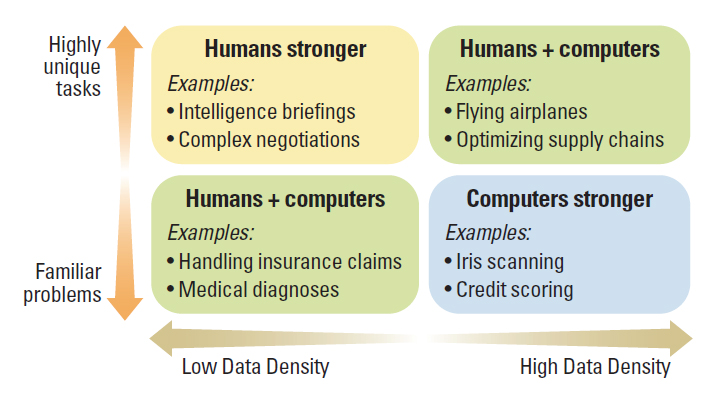
The Comparative Advantages of Humans and Computers
“Whether humans or computers have the upper hand depends on many factors, including whether the tasks being undertaken are familiar or unique. When tasks are familiar and much data is available, computers will likely beat humans by being data-driven and highly consistent. Although artificial intelligence is advancing rapidly, a general rule of thumb is that when tasks are unique and when data overload is not a problem for humans, humans likely have an advantage. In many situations, the strongest performance comes from humans and computers working together.”
Paul Schoemaker and Phillip Tetlock in “Building a More Intelligent Enterprise”
Originally curated in May 2018; still seems accurate.
+ + +
“All work is the avoidance of harder work.”
James Richardson
It does not seem like folks using AI are working less hard. They are getting more done but working as hard or harder than before, with perhaps two caveats:
- In the same way that heavy machinery saves humans from backbreaking labor, AI’s tireless clerical labor saves them from having to concentrate on a wealth of details and make fine distinctions in very limited time. So some very tiresome labor is now obsolete. It’s similar to a search engine filtering a pile of documents to find a handful containing a particular word or phrase.
- The effort has shifted more to specification and planning and then review at a high level of results and output. For an essay, it’s less about checking for spelling mistakes and grammatical errors and more about the organization of the material and the flow of the argument or narrative. For software, it’s less about syntax and more about assessing architectural trade-offs and maintainability.
+ + +
“Data is the new oil. Like oil, data is valuable, but if unrefined it cannot really be used. It has to be changed into gas, plastic, chemicals, etc. to create a valuable entity that drives profitable activity. Data must be broken down and analyzed for it to have value.”
Clive Humby in 2006
h/t James Butcher
+ + +
“There is a growing mountain of research. But there is increased evidence that we are being bogged down today as specialization extends. The investigator is staggered by the findings and conclusions of thousands of other workers–conclusions which he cannot find time to grasp, much less to remember, as they appear. Yet specialization becomes increasingly necessary for progress, and the effort to bridge between disciplines is correspondingly superficial.”
Vannevar Bush in “As We May Think”
+ + +
“Our methods of transmitting and reviewing the results of research are generations old and now totally inadequate. […] Mendel’s concept of the laws of genetics was lost to the world for a generation because his publication did not reach the few who were capable of grasping and extending it; this sort of catastrophe is repeated all about us, as truly significant attainments are lost in the mass of the inconsequential.”
Vannevar Bush in “As We May Think“