
Always be collecting data and perspectives; always be connecting the dots you have gleaned from these data points and perspectives.
Always Be Collecting Data
- “Always trust your client—and cut the cards.” Weinberg’s Sixth Rule of Trust
- Always be collecting data.
- Always be collecting multiple perspectives.
- “Always Be Collecting Data” The rule of ABCD
- “In God We Trust, All Others Bring Data” attributed to W. Edwards Deming
- Possibly a riff on “In God We Trust, All Others Pay Cash”
- In closing… “‘A,’ ‘B,’ ‘C.’ ‘A,’ always, ‘B,’ be, ‘C,’ closing. Always be closing.”
- from Blake’s speech in Glengarry Glen Ross (screenplay by David Mamet)
- Productivity is never an accident. It is always the result of a commitment to excellence, intelligent planning, and focused effort.” Paul J. Meyer
- “The best way out is always through.” Robert Frost
- https://www.gapingvoid.com/information-vs-knowledge/
- try to put some numbers on it. Lord Kelvin, “When you can measure what you are speaking about, and express it in numbers, you know something about it; but when you cannot measure it, when you cannot express it in numbers, your knowledge is of a meager and unsatisfactory kind.”
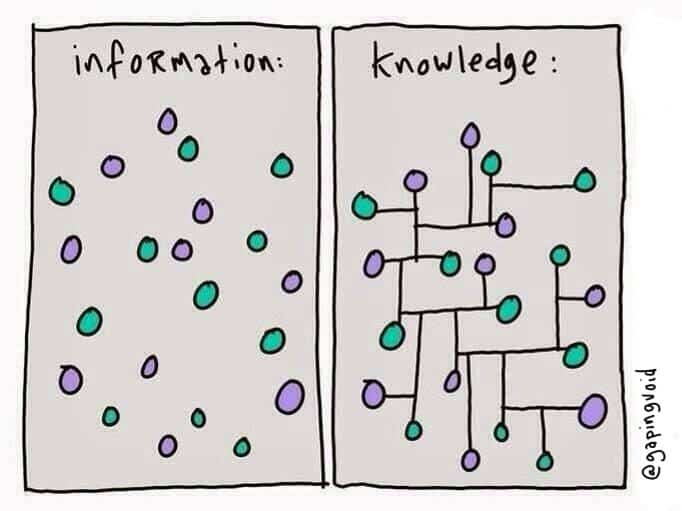
Always Be Collecting Dots, Always Be Connecting Dots
Dots are information. The more information you collect, the more frequently you can make meaningful connections that can make other people feel good and give you an edge in business. Using whatever information I’ve collected to gather guests together in a spirit of shared experiences is what I call connecting the dots.
If I don’t turn over the rocks, I won’t see the dots.
If I don’t collect the dots, I can’t connect the dots.
If I don’t know that someone works, say, for a magazine whose managing editor I happen to know, I’ve lost a chance to make a meaningful connection that could enhance our relationship with the guest and the guest’s relationship with us. The information is there. You just have to choose to look.
Danny Meyer in Setting The Table
….
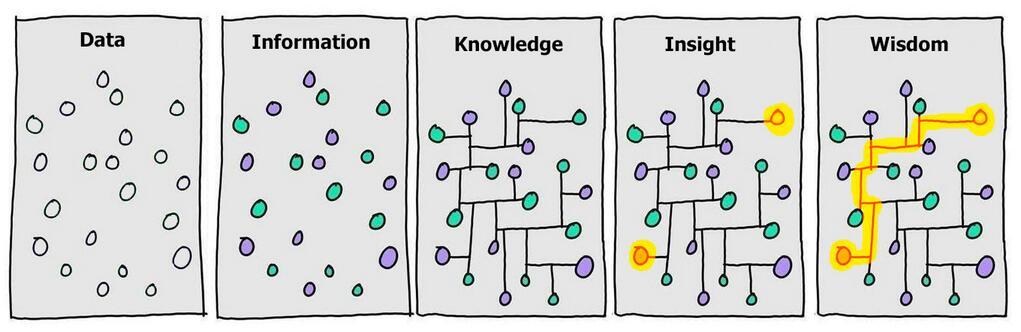
“ABCD simply means Always Be Collecting Dots so you can Always Be connecting Dots. Some people would rather call dots data, but when I talk about a dot, I’m talking about a morsel of information that matters to you. And if it matters to you, then it better matter to me. Because if I want to matter to you, I’d better care about what’s important to you.
Danny Meyer in “Invest Like the Best Ep 203” starting at 14:31
Postscript: trying to find early sources
“The most dangerous thing about investors is their indecisiveness. The worst case scenario is the long no, the no that comes after months of meetings. Rejections from investors are like design flaws: inevitable, but much less costly if you discover them early.
So while you’re talking to investors, constantly look for signs of where you stand. How likely are they to offer you a term sheet? What do they have to be convinced of first? You shouldn’t necessarily always be asking these questions outright—that could get annoying—but you should always be collecting data about them.”
Paul Graham in “A Fundraising Survival Guide” (Aug-2008)
+ + +
Here is the oldest reference I could find but I suspect it’s not the original use of “always be collecting data.”
A Stock Solution for Everyday Questions
[a list of questions on promotion for wallpaper]
Some of your dealers, no matter what your line, are successfully handling every problem or question or difficulty that may be harassing the majority of your dealers.
The thing for the manufacturer to do, therefore, is to find out how these enterprising dealers are meeting specific problems in their business. And then pass this information on all dealers.What the dealer asking the question wants to know is what some dealer in the same business in a similar locality, and operating under similar conditions is doing. Somewhere there is such a dealer who is making a success of his business.
A description of his method should be passed on to other dealers who are not so successful.There isn’t anything new about this suggestion. It’s essentially the basic idea of the sales promotion methods. As such well-known firms as [list of well known firms in 1925] The trade promotion advertising and other literature of these concerns is always filled with “success stories.” The name of the dealer, his address, and a full description of his accomplishments are always given.
Every manufacturer should always be collecting data of this kind.
The information is not easy to get, however. Salesmen should be instructed to keep their eyes peeled for success stories.
Answer to a letter by Ellis T. Morris of the Niagara Wall Paper company, Niagara Falls, NY to the editor of “Printers’ Ink” (May 7, 1925) bold added
I originally used “always be collecting data” on the SKMurphy Blog on Nov-29-2010 in “Keeping Your Customer’s Trust” Under Law 6 in Weinberg’s Laws of Trust. “Always trust your client–and cut the cards.” My comment was “Always be collecting data. Always be collecting multiple perspectives.”
I recall seeing this phrase in a presentation as “ABCD – Always Be Collecting Data,” in the late 1980s or early 1990s. It may been a riff by the presenter on the Glengarry Glen Ross movie speech by Alec Baldwin where he writes “ABC – Always Be Closing” on the chalkboard during a briefing for the sales team.
Image Credits: Hugh MacLeod (GapingVoid)