
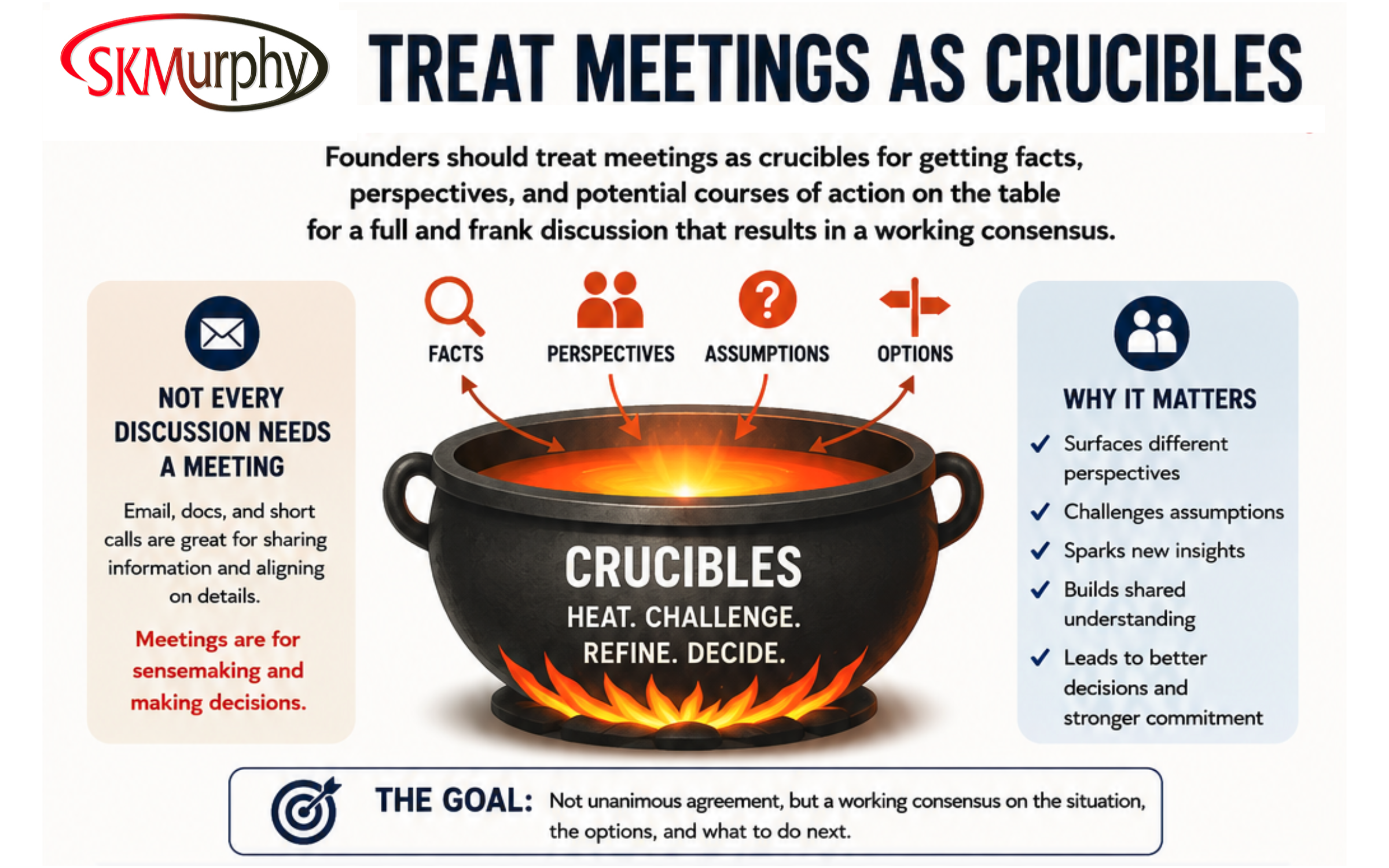
Founders should treat meetings as crucibles for getting facts, perspectives, and potential courses of action on the table for a full and frank discussion that results in a working consensus.
Treat Meetings As Crucibles
Audience: I wrote this for bootstrapping founders managing the dynamics of a team meeting with four to sixteen people. I think a two- or three-person conversation will also benefit, but there is a phase transition that seems to occur at four to five people up to about 16 where it’s easier to run one large meeting that may include not only employees but contractors, consultants, and partners who are legitimately involved in a significant decision.
In larger firms, perhaps one you left to launch your startup, you might hear after a meeting, “That should have been an email!” And there are advantages to laying the groundwork for an effective discussion by preparing a detailed analysis with well-thought-out models and clear diagrams, and putting it all in an email. Many details can be addressed over email or a short phone call, but significant decisions often require insights from multiple team members in a synchronous discussion that can spark new insights.
Here are some of my rules of thumb for navigating conversations that may become challenging.
- Address issues promptly but prepare: sleeping on it and putting your thoughts in writing can often make for a more productive conversation.
- Listen and check understanding: ask clarifying questions and accurately summarize what you heard to confirm shared understanding.
- Stay calm and respectful, and avoid defensive responses. Take a break to maintain equanimity.
- Keep your statements brief and on point. Don’t interrupt, and don’t repeat yourself unless asked to clarify.
- Don’t suggest solutions until you have a rough consensus on a problem or need. Don’t select a solution until you have evaluated at least two alternatives to the status quo.
- It’s OK to disagree on the situation or a course of action in any one conversation or sequence of conversations: commit to finding a workable solution.
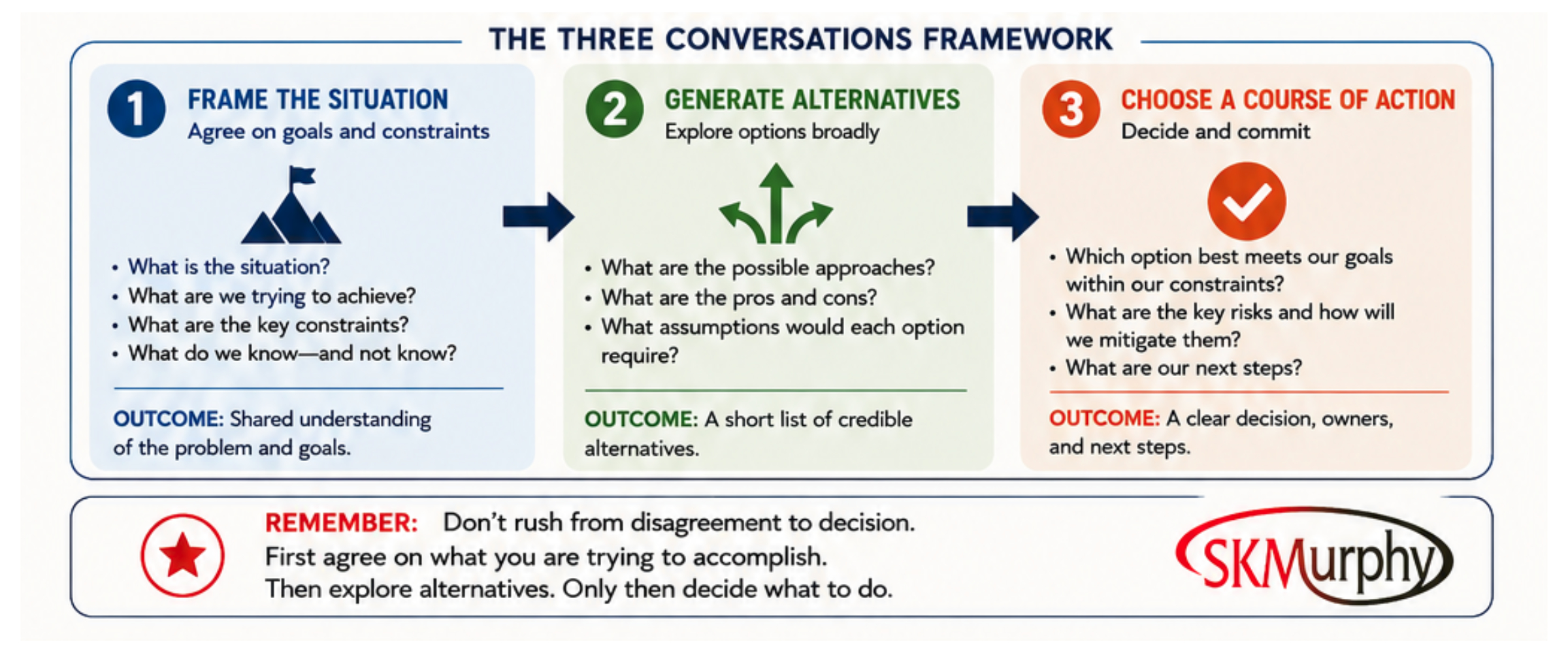
- You need at least three conversations: one to frame the situation and agree on goals and constraints, one to generate alternatives, and one to choose a course of action.
Where there are informed opinions suggesting different approaches or stakeholders with strong feelings, getting to a real decision and a working consensus requires a discussion that is intense enough to encourage change without destroying the structure of the team or critical relationships. A working consensus does not mean the team is agreed on all points, but it does mean the team has agreed on the essential aspects of a common plan for moving forward. An essential aspect of leadership that founders can neglect to their disadvantage is not listening and playing back key points so that everyone feels heard. It’s also OK to change your mind based on input and feedback from the team.
Major Decisions Benefit from Three Conversations
Many decisions can be delegated or managed in a single team meeting, but the major decisions that occur several times a year (and perhaps more frequently in the first year of full-time operation with a team of four or more) benefit from the three-conversation approach that separates framing, generating alternatives, and choosing a course of action.
In addition to a full and frank exchange of views in the meeting, the decisions must be captured and communicated. Ideally keep points are captured in writing during the meeting. Clear communication and established expectations are the hallmarks of successful working relationships. A defined consideration period, a record not only of decisions but also of the reasons for those decisions, and organized team meetings contribute to this.
Related Blog posts
- Finding Common Ground and Workable Solutions
- Lisa Solomon: Effective Meetings Choose One of Reaching Understanding, Generating Options, or Making Decisions
- How to Tell When Your Team Has a Workable Plan of Action
- Finding Common Ground and Workable Solutions
- Time to Market: Making Tough Decisions as Founders
- Is it Prudence or Procrastination?
- Kierkegaard on the Art of Helping Others to Understand
- Constructive Pessimism
- A Clear Eyed View Of The Way Forward
- The Best Bad Plan
Image Credit: images (c) Theresa Shafer, created using ChatGPT and manual edits to output.
This article was republished on LinkedIn at https://www.linkedin.com/pulse/treat-meetings-crucibles-sean-murphy-x3edc/
Postscript: Why Crucible?
“A crucible is a container that can withstand very high temperatures and is used for metal, glass, and pigment production as well as a number of modern laboratory processes. While crucibles historically were usually made from clay, they can be made from any material that withstands temperatures high enough to melt or otherwise alter its contents.”
Wikipedia Crucible