Archive for March, 2010
March 31st, 2010
You can follow @skmurphy to get these hot off the mojo wire or wait until the end of the month when they are collected on the blog. Enter your E-mail if you would like Feedburner to deliver new blog posts to your inbox.
+ + +
“To have what you want is riches, to be able to do without is power.”
George MacDonald
+ + +
“And the man in the suit has just bought a new car,
From the profit he’s made on your dreams”
Jim Capaldi “The Low Spark of High Heel Boys”
+ + +
“The entrepreneur always searches for change, responds to it, and exploits it as an opportunity.”
Peter Drucker
+ + +
“Real world tests are all open book: lessons gleaned from the free market inexorably determine success.”
Jonathan Rosenberg
Full quote:
“In the real world the tests are all open book, and your success is inexorably determined by the lessons you glean from the free market.” from Jeff Jarvis “TEDxNYed: This is Bullshit“
+ + +
“Our history is slow, continuous growth. In the race between tortoise and hare, well, we’re the slow guy”
Craig Newmark
This was Newmark’s answer to “How Craigslist Spread” is worth keeping as your screen saver quote. See also “Sustaining is More Important Than Starting”
+ + +
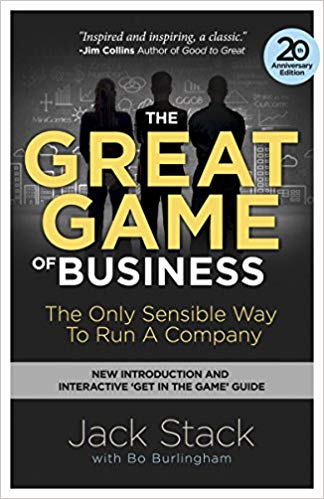
“A business should be run like an aquarium, where everybody can see what’s going on.” Jack Stack “The Great Game of Business” (page 72)
Full quote:
“A business should be run like an aquarium, where everybody can see what’s going on–what’s going in, what’s moving around, what’s coming out. That’s the only way to make sure people
understand what you’re doing, and why, and have some input into deciding where you are going. Then, when the unexpected happens, they know how to react and react quickly.”
The Great Game of Business site also lists simulations, webinars, coaching and more on open book management. See also “The Business is Everyone’s Business”
+ + +
“The most profound technologies are those that disappear. They weave themselves into the fabric of everyday life until they are indistinguishable from it.” Mark Weiser in “The Computer for the 21st Century,” Scientific American, vol. 265 (September 1991): 94–104.
+ + +
“We missed good startups, usually good guys with a terrible idea. Now we focus more on the people than the idea.”
Paul Graham
Full quote from Hacker News Item 1192178:
“We’ve definitely missed good startups. But one advantage of having so many competitors is that we’re much more likely now to learn when we screw up. When a startup from one of the other YC-like organizations does well, I often check their YC application to see how we missed them. Usually it’s because they were good guys but working on a terrible idea, which they later changed. So in response to that we now make a conscious effort to pay less attention to the idea and more to the people when we read applications.”
In response to “Ask HN: Who got rejected in earlier cycles of YC application and made it anyway?”
+ + +
“Our plan for 2010: kill initiatives we can’t fix, experiment cautiously, and treat social capital with the same care as cash.”
Sean Murphy
See also “Conserving Trust in a Downturn” & “Bouncing Back”
+ + +
“The secret of happiness is curiosity”
Norman Douglas “The South Wind“
Full quote:
“A sound schooling should teach manner of thought rather than matter. It should have a dual aim—to equip a man for hours of work, and for hours of leisure. They interact; if the leisure is misspent, the work will suffer. As regards the first, we cannot expect a school to purvey more than a grip of general principles. Even that is seldom given. The second should enable a man to extract as much happiness as possible out of his spare time. The secret of happiness is curiosity. Now curiosity is not only not roused; it is repressed. You will say there is not time for everything. But how much time is wasted!”
+ + +
“Companies that truly want to create a long-term capability around innovation need to invest in building a common language.”
Dr. Clayton Christensen
+ + +
“A toolmaker succeeds when customers succeed with his aid: e.g. a sword-smith succeeds when clients die of old age.”
Fred Brooks
Full quote:
“A toolmaker succeeds as, and only as, the users of his tool succeed with his aid.
However shining the blade, however jeweled the hilt, however perfect the heft, a sword is tested only by cutting. That sword-smith is successful whose clients die of old age.”
Source: Fred Brooks “The Computer Scientist as Toolsmith”, Comm ACM 39(5), March 1996
+ + +
“Salvation comes to him who never ceases to strive.”
Goethe
+ + +
“Judge a man by his questions rather than by his answers.”
Voltaire
March 30th, 2010
In “Killer Instinct” Rafael Corrales writes:
There are no plus-minus stats to measure a player’s ruthlessness, his desire to beat his opponent so badly he’ll need therapy to recover. [...]
Athletic greats squeeze every ounce out of their abilities. That drive and hunger is worth noting, since top athletes are typically not satisfied even when pulling in accolades, championships, and money.
Instead of measuring success relative to the general population, or a peer group, the great ones measure success relative to their potential and abilities. It’s clear this also applies to startups.
I encourage everyone I know to go start something if they’ve at least proven there’s a market need. I bet that the people who will be great are the ones who have a killer instinct to succeed.
If by killer instinct he means the value of focus then I agree.
But I find most startups succeed more on their ability to negotiate win-win outcomes with partners, customers, suppliers and less on “winner take all” models. Most markets look more like stag hunts where teams of cooperating players outperform “go it alone” firms. If a startup team sets high standards of excellence for performance that’s great.
But you face so many competitors, including the status quo, that a focus on winning can lead to you to overlook opportunities for partnering. Especially in the early market. In “What makes entrepreneurial” Saras Sarasvathy writes:
“Expert entrepreneurs […] are actually in the business of creating the future, which entails having to work together with a wide variety of people over long periods of time. [They fill their future] with enduring human relationships that outlive failures and create successes over time”
“This is largely ignored in our entrepreneurship curricula which tend to focus on market research, business planning, new venture financing and legal issues. As far as I know no entrepreneurship programs offer courses in creating and managing lasting relationships or stable stakeholder networks, nor on failure management.”
See also: “Saras Sarasvathy’s Effectual Reasoning Model for Entrepreneurs”
March 25th, 2010
Tien G. Nguyen suggested three filters for a good business idea:
- Solve a problem that he has personally.
- Solve a problem that customers will pay you immediately to solve.
- Solve a problem that is a real one for customers.
What I think he is looking for in #1 is a problem that he has some useful knowledge about. Another way to say what I mean is that it should be become something that he can add unique value to, based on experience, expertise, or skills.
I think it’s stronger if you reverse the order to be:
- Solve a real customer problem,
- That they are willing to pay for,
- Where you add unique value (know-how, experience, or expertise) to the solution.
March 23rd, 2010
I was delighted when Bill Meade, President of Basic IP Management, Inc. agreed to an interview about managing innovation and intellectual property to maximize profits. Bill served as Intellectual Property Manager and Future Products Manager at Hewlett-Packard, where he “lit the fire” that moved HP from #18 in US patenting to #3. He has run over 200 invention workshops around the world.
Q: What are some of the surprising things you have learned about inventors?
A: My three biggest surprises have been about prolific inventors.
- Nobody knows who they are.
Example: Last workshop we ran, the top inventor turned in over 30 complete invention disclosures. The IP attorneys had never seen him before. The way you find them is by asking everyone to invent.
- They are as motivated by peer pressure as by incentives, you don’t need to motivate them directly.
Example: One prolific inventor went from 12 disclosures per year to 200 per year after we started running invention workshops at his company, but he never went to a workshop. Just increasing awareness of the amount of inventing in the environment motivates prolific inventors.
- Prolific inventors are contagious.
Example: Another prolific inventor at HP became an on-ramp for the IP department finding inventing talent by bringing groups of not-yet-inventors to weekly invention office hours to learn how to complete disclosures.
Q: How do you define Intellectual Property (IP)?
A: We define IP as products of the human mind that have commercial value and are legally defensible. This includes patents, trade secrets, and copyright material. It also includes the defensive publication of ideas, which prevent their use as patents by competitors. If you look at managing IP at a company like IBM, they actively manage all four of these forms of intellectual property.
Q: Based on your experience, how do VPs of R&D/Engineering look at the managing IP?
A: In my experience R&D management tends to under value IP creation and management because they are not measured on it directly. It’s hard to measure: the effects of a strong or weak approach can take years to manifest. Invention disclosures, patent filings, and patents granted are all lagging indicators and are still only a poor proxy for patents successfully litigated or licensed.
Q: What are the aspects of developing and managing IP that get underestimated?
A: One of the biggest is how much more intellectual property their people can document and allow the corporation to protect if properly encouraged. This latent and often untapped potential for additional IP can be encouraged and directed toward the strategic objectives of the corporation. Many companies pay bonuses for invention disclosures and patents, but they underestimate the value of allocating blocks of time to writing invention disclosures and simplifying both the disclosure forms and the evaluation process so that they are much less of a burden on the potential inventor.
Q: What drives IP strategy?
A: Most IP strategy is developed in response to an IP crisis, for example being sued unexpectedly. Once an IP crisis happens, the company will start climbing the IP management learning curve, with management, lawyers, outside consultants, all hands scrambling.
The only good thing about an IP crisis is that the need for additional IP to manage the situation becomes crystal clear.
The biggest problem with managing IP by crisis is that very little long-term learning happens from crises. The litigators declare victory and move on to the next crisis. The managers are just happy to have the situation closed. Corporate counsel is left burned out and un-thanked. IP portfolio managers having survived litigation often leave their position, and often, their company.
Q: OK, so what should drive IP strategy?
A: We think there are perhaps a half dozen good answers:
- Protect sales & product differentiation
- Stop competitor formation
- Buy oligopoly membership
- Solve patent crises
- Reduced litigation
- License revenue
Q: What are some better practices you have seen at the engineering leadership level?
A: Several best practices for creating business value by defining and implementing an IP strategy:
- Target the inventing you want
- Tell your inventors what you want them to invent and why
- Train your inventors and transfuse them with enthusiasm for inventing.
- Measure using an objective rating process and provide quantitative feedback from idea rating.
- Provide infrastructure for closed loop feedback between IP team and inventors.
More background on Bill Meade
Bill Meade is President of Basic IP Management, Inc. Prior to Basic IP, Bill served as Intellectual Property Manager and Future Products Manager at Hewlett-Packard with responsibilities including managing the business side of patent litigation, implementing IP strategy, damages estimation, increasing the strategic alignment of IP to LaserJet businesses, IP business process development including a world-wide invention incentive payment system. Bill “lit the fire” that moved HP from #18 in US patenting to #3, running over 200 invention workshops for HP across the US and around the world. Bill has also served as Assistant Professor of Marketing at University of Missouri, where he moderated internet discussion lists for Geoffrey Moore and Guy Kawasaki. Bill holds a BA in Finance, an MBA in marketing, and a Ph.D. in marketing with minors in evolutionary ecology, econometrics, statistics, and electrical engineering, all from Michigan State University – The Eli Broad Graduate School of Management.
March 21st, 2010
I had an e-mail exchange with William Pietri (@williampietri) back in October that I am reproducing here with his permission. I believe that it highlights a set of issues around “being in the grip of a vision” in a useful way.
William Pietri: I’m wondering how Lean Startup founders handle attacks of vision. Do you just sit still until it passes? Do you take to strong drink? Do you, like a werewolf before the full moon, lock yourself in a cage until you’re no longer dangerous?
Sean Murphy: If you didn’t believe that you could make the world a better place you wouldn’t be effective as an entrepreneur. I think vision is an important component to both inspiring and sustaining successful entrepreneurial endeavors. Necessary but not sufficient as the math majors say.
Pietri: In all seriousness, I keep running across entrepreneurs who have both the blessing and the curse of a strong product vision. So strong that they don’t feel the need to actually ship anything to see what customers think. Because of course it will work. Or at least they keep wanting to delay real-world feedback so that they can get the product “right”. Ha ha, “right”.
Murphy: We call this the “need to leave the Bat Cave and listen to strangers” as a lot of typically introverted technical entrepreneurs feel more comfortable continuing to perfect their craft/technology in a private workspace (or a secret hideout if they are in stealth mode).
Pietri: I occasionally have this problem myself, and I mainly deal with it by writing up ideas in my notebook, sketching out user interfaces, or producing stacks of index-card based product plans. Then I find the smallest shippable thing I can implement and push the pile of paper aside. Generally to be ignored for weeks or months.
Murphy: I think it’s good to explore the limits of the vision as long as you take the time to break it into a phased implementation, that you way know where you are trying to go and can put you first steps in a larger context. If you
were to sketch a “five phase plan” it’s better if you can actually begin in phase two and determine what earlier efforts you are building on (vs. starting from scratch).
Pietri: Do Lean Startup founders have any tricks for breaking their attachment to grand visions? Or even better, tricks for getting other people to wean themselves off self-feedback in favor of real-world feedback?
Murphy: The trick is not breaking your attachment to your vision, it’s breaking your vision it into steps.
I would also take a hard look at why you don’t feel a deadline–and the typical deadline for bootstrappers is caused by running out of money. Sometimes it’s too obliging a wife, girlfriend, parents, wealthy relative that is funding your efforts without asking you when you are going to ship or setting a funding limit. Sometimes it’s having a day job or successful consulting practice that puts off the need to actually make money from a new product.
Sometimes your identity is caught up in being an inventor and you don’t want to find out for real (the product can be a little bit like Schrodringer’s Cat, as long as you don’t open the box and test it in the market you can believe that it’s still alive) if people want to use–much less pay for–your product.
Net net: self-feedback can satisfy many needs but it won’t make you money; when you need to make money you need to have conversations with strangers and get “real world feedback.”
At least that’s what I try to remind myself of when I am in the “grip of a vision.”
Related Posts:
March 20th, 2010
Dave Concannon left a long and thoughtful comment on yesterday’s “The Business of Everyone’s Business”
Great article Sean.
Recently, a developer I work with sent a mail around to the (small) team that blew me away. After a glitch with an internal system he sent a mail which read: “Who’s job is it to fix this?”.
When you have someone who can’t take personal responsibility for something that falls directly within their skill set, I’d be wary of their direct involvement in the bigger picture.
Certainly, their opinion is as valid as anyone else’s. Even just ensuring that every section of the business knows what everyone else is doing works well – internal newsletters, some sort of internal social network on yammer or ning etc helps.
My feeling is that there are two types of people – one group just need to be told what to do, the other need to be given the space to develop great ideas (be they business, technical etc). Mixing these types up may be disastrous. If you have too many of the first type, it might be that your hiring process needs attention. I blogged about this in more detail at “How to Run a Company into the Ground.”
In Dave’s formulation there are two kinds of people
- A People who just need space to be able to develop great idea.
- B People who just need to be told what to do.
I think he needs more than a one bit encoding for people’s values, skills, and task relevant maturity.
Task relevant maturity is a person’s experience with the particular task and prior performance of it. I believe that it was coined by Blanchard and Hersey in “Management of Organizational Behavior” as a part of their situational leadership model (originally called “life cycle leadership model”).
I like Andrew Grove’s “High Output Management“ suggestions for how to select the right management style for the individuals task relevant maturity (from page 175):
Task Relevant
Maturity |
Appropriate Leadership Style |
| Low |
structured and task oriented, tell “what”, “when”, and “how” |
| Medium |
individual oriented, emphasis on two way communication, support, and reasoning |
| High |
minimal management involvement, establish objectives and monitoring |
Grove has two suggestions for the level of monitoring that “apply quality assurance principles”:
- Monitor at the lowest value added stage in the process. For example, review *rough drafts* of reports that have been assigned, don’t wait for a subordinate to spend time polishing them into final form when you have a problem with the contents.
- Check more frequently depending upon his task relevant maturity and how dynamic the environment that he is operating in.
Grove’s book has a number of excellent suggestions for management techniques that are very applicable to the challenges bootstrapping entrepreneurs face.
I had two other thoughts on Dave’s example.
- Everyone benefits from checklists. Even experts benefit, consider an experienced flight crew doing a pre-flight checklist each time they prepares for take-off. Checklists free up your focus for the hard problems and the real risks and uncertainties that the organization faces. As an organization grows, formal policies make for a predictable customer experience (certainly a key element of any brand promise). It doesn’t mean that they should be followed blindly.
- Skill deficits can be addressed, values conflicts are often difficult to resolve. I think it’s also important to distinguish between experience or skill mismatches to task needs, which can be addressed with appropriate management and training, and values conflicts between and individual and team or firm culture. That latter are much more difficult to address. The developer asking “whose job is this?” in Dave’s example may be experiencing a values conflict as much as a lack of task relevant maturity.
Unlike Dave’s static model Grove suggests that training that increases employee task relevant maturity increases management leverage and reduces the amount of time that needs to be devoted to managing a subordinate. I think that this is something founder’s sometimes have trouble with, learning how to train and delegate so that they can continue to scale the organization can often feel like loss of control.
Note: Grove’s model is simpler in some ways than the situational leadership Tell, Sell, Participate, Delegate model but his stress of the need to establish objectives and monitoring and his focus on increasing managerial leverage make it a better approach for startup entrepreneurs in my opinion.
March 19th, 2010
“A business should be run like an aquarium, where everybody can see what’s going on–what’s going in, what’s moving around, what’s coming out. That’s the only way to make sure people understand what you’re doing, and why, and have some input into deciding where you are going. Then, when the unexpected happens, they know how to react and react quickly. ”
Jack Stack “The Great Game of Business” (page 72) see also http://www.greatgame.com/
Edward Carrel left a great comment on Hacker News in response to “Project Manager’s vs. Developer’s View” this quote (the thread is here)
I’ve never understood this bright line boundary between the patchwork of people that make up a technical group, and the patchwork of people that make up a business group. Presumably, the technology being developed is part of what makes the business viable; it isn’t just a bunch of people playing with text editors on company time, while the grown ups — the business folks — do everything that earns money.
It serious just seems like an artificial division to excuse the two groups for not listening to each other.
This becomes even more painful when you are one of the people who wants to be involved in whatever makes up this nebulous “business side”, and are told to go back to writing code.
My view: the business is everyone’s business, and any time you start developing bright line boundaries to either protect turf, enforce a hierarchy for its own sake, or excuse non-involvement, the least of your problems is one of your techies wanting to play with technology that seems superfluous to the untrained eye.
It reminded me a few paragraphs from an E-mail I sent to a client recently.
You have created a significant business opportunity with your accomplishments: you have happy customers, strong technology, and the demonstrated ability to close new business.
But I see the need for closer cross-functional coordination between sales, marketing, development, and customer service with clear agreement on both near term and long term strategy.
These four teams need to work together more closely to leverage your significant strengths and accomplishments. Closing new business opportunities and increasing penetration at existing customers is going to take more communication and continuous collaboration.
I think there are several things that work against effective cross-functional collaboration:
- Time pressure: trust is built over time and developing a working consensus on a course of action takes extra time until everyone is in at least rough agreement on goals, roles, and process.
- Different perspectives: software is easy to change and update; customers are much less forgiving and typically not interested in the reasons that you let them down.
- Shared improvisation requires rehearsal, and rehearsal takes even more time. But you often don’t have a second chance with a customer.
- It requires you to admit your dependency on others with fundamentally different strengths. Many founders in particular have very strong skills in at least one or two areas and can fall victim to favoring their strengths instead of taking advantage of different approaches that require other people with talents that the founders lack.
- Software is the promise of a relationship but relationships are much more ambiguous than test results, transactions, or program output. Different groups live in different world with different score keeping mechanisms.
Figuring out the right team and company scorekeeping mechanisms and building trust and shared improvisational skills all take time. But I agree with Ed Carrel that the business is everyone’s business.
See also “The Business is Everyone’s Business (Part 2)” and these related blog posts:
March 18th, 2010
In “Moore’s Law Beats Customer Feedback” Chris Morris highlights a quote by Jensen Huang from an April 8, 2009 talk at the Stanford Technology Ventures Program on “Favoring Moore’s Law Over Customer Feedback“ (Mr. Huang has a number of talks available on Stanford’s Entrepreneurship Corner):
Sometimes you have to ignore your customers and follow Moore’s Law.
My feeling is that Moore’s Law is customer feedback.
What I think he means “ignore some of your more established prospects.” NVIDIA sold chips to customers in its first five years. By that I mean that they had customers that were using their products. Just not to some of his larger potential prospects. NVIDIA also had SGI as an “existence proof” for a market for high end graphics. They had lead customers from the beginning, he doesn’t mention who they are, choosing to focus on the larger prospects who were initially not interested, but they didn’t invent their architecture in a vacuum. For example, from Firing Squad’s History of NVIDIA:
Curtis Priem, NVIDIA Chief Technical Officer, had been the architect for the first graphics processor for the PC, the IBM Professional Graphics Adapter, and more recently had developed the GX graphics chips at Sun Microsystems. Chris Malachowsky, VP of Hardware Engineering, was a Senior Staff Engineer for Sun Microsystems, Inc., and was co-inventor of the GX graphics architecture.
In fact, when it came to standards for representing 3D they initially picked the wrong standard and had to “listen to their customer” and change horses. See, for example Tom’s Hardware: 13 years of NVIDIA History:
The principal problem with the NV1 was in its management of 3D: it used quadratic texture mapping (QTM) instead of the technique used currently, which is based on polygons. DirectX appeared just after the card was released, and it used polygons, so the NV1 was a failure over the long term. [...] The NV2 used the same rendering method and was never completed. It was to have been used in the Dreamcast console (which replaced the Saturn), but Sega finally chose a polygon-based technology (PowerVR) and Nvidia abandoned QTM in favor of polygon-based rendering with the NV3.
My take away is that if a large established customer shows no interest, talk to smaller players who are interested in becoming larger and help them to disrupt the market. Don’t wait for the established players to embrace your product idea before proceeding.
March 17th, 2010
Create and Deliver Surprisingly Compelling Software Demonstrations
“Do The Last Thing First” — the recipe for a Great Demo!
When: Friday, April 9, 2010
- 8:15 am – 5:00 pm
- Advanced Topics PM Session: 1 – 5pm (see below)
Where: Moorpark Hotel, 4241 Moorpark Ave, San Jose CA 95129
Cost: $560
This is an interactive workshop with Peter Cohan geared especially for you who demonstrate B-to-B software to your customer and channels. Bring a copy of your demo and be prepared to present it — we’ll help you turn it into a surprisingly compelling demo! AM Session Cost (includes breakfast, lunch, copy of Peter Cohan’s “Great Demo!” book):
This seminar outlines a framework for the creation and delivery of improved demos and presentations to enable increased success in the marketing, sale, and deployment of software and related products. Whether it’s face to face, in a webinar, as a screencast, or as a self-running demo the ability to present the key benefits of your software product is essential to generating prospect interest and ultimately revenue. Peter Cohan of The Second Derivative gives us the recipe for a Great Demo!
“I am confident that with the insights gained from your workshop we will land more customers in fewer iterations.”
Lav Pachuri, CEO, Xleron Inc.
“Peter Cohan’s Great Demo method really works. It helped us win DEMOgod, and it has allowed us to explain our offering much more clearly to prospects.”
Chaim Indig, CEO, Phreesia
(See “DEMOgod Winner Phreesia Praises Peter Cohan Training“)
ABOUT THE SPEAKER: Peter Cohan, Principal at Second Derivative
Community Web Site: www.DemoGurus.com
Peter Cohan is the founder and a principal of The Second Derivative, a consultancy focused on helping software organizations improve their sales and marketing results. In July 2004, he enabled and began moderating DemoGurus®, a community web exchange dedicated to helping sales and marketing teams improve their software demonstrations. In 2003, he authored Great Demo!, a book that provides methods to create and execute compelling demonstrations. The 2nd edition of Great Demo! was published March 2005.
Before The Second Derivative, Peter founded the Discovery Tools® business unit at Symyx Technologies, Inc., where he grew the business from an empty spreadsheet into a $30 million operation. Prior to Symyx, Peter served in marketing, sales, and management positions at MDL Information Systems, a leading provider of scientific information management software. Peter currently serves on the Board of Directors for Collaborative Drug Discovery, Inc. and the board of advisors for Excellin, Inc. He holds a degree in chemistry.
Peter has experience as an individual contributor, manage and senior management in marketing, sales, and business development. He has also been, and continues to be, a customer.
Agenda:
- 8:15 AM Breakfast & Registration
- 8:30 AM Workshop begins
- Noon Lunch & De-brief
- 1 PM Wrap up
Seating is Limited These are intensive sessions and we ask that you arrive at least 15 minutes before 8:30AM start time to ensure you will have a seat and won’t disrupt the session once it is underway.
PM Session: Advanced Topics
In response to requests for assistance on demo delivery we have added an afternoon session to our Great Demos workshop. If this is your first exposure to the Great Demo come for the morning and get a great overview of the methodology and stay for the afternoon if you would like an opportunity for more interactive training on advanced topics such as multi-solution, multi-player demonstrations, and vision generation demonstrations. The advanced topic session as covers real life issues like handling bugs, crashes, and time challenges.
This is an interactive workshop with Peter Cohan is only available to people who have already attended the morning session or a previous Great Demo session.
When: Wednesday March 17, 2010 1:00 – 5:00 pm
Where: Moorpark Hotel, 4241 Moorpark Ave, San Jose CA 95129
Cost $200 Register for the Advanced Topics
Advanced Topics Agenda:
- 1 PM Advanced Topics
- multiple solution demos
- presenting to a mixed audience with different needs or information requirements
- vision generation demonstrations
- handling bugs, crashes, and time challenges.
- 5 PM Wrap up
For more information: Theresa Shafer 408-252-9676 events@skmurphy.com
March 13th, 2010
I got an e-mailed question from someone who had watched my “The Limits of I’ll Know It When I See It” video.
Q: In your talk you say “Most recurring problems are a combination of an unsolved technical problem and an unresolved emotional component to that problem.” Is there more about this in Ericsson’s “The Role of Deliberate Practice in the Acquisition of Expert Performance” or in the Gary Klein’s “Sources of Power“?
A: It’s actually from another great book: ” The Art of Learning” by Josh Waitzkin. I found this quote on page 108:
“The aim is to minimize repetition as much as possible, by having an eye for consistent psychological and technical themes of error.”
but he is a little clearer in two other interviews, the first is Scott Barry Kaufman’s “Learning About Learning: An Interview With Josh Waitkzkin“ (yellow highlight added)
S. In reading your book, it seems as though your major strength in Tai Chi Chuan is the way you put your mind into the game. You were able to beat players much stronger than you by “getting into their mind.” I find this fascinating. Why do you think you were so good at psyching people out? Was it because of your early chess experiences?
J. Sure, my chess experience taught me a lot about the psychology of competition. World-class chess players are incredibly brilliant people who have spent their lives figuring out ways to get it your head, to break you down. Usually every high level chess error is accompanied by a psychological break of sorts-to survive, you have to understand the inner game. I am always looking for where the psychological and the technical collide–that surely comes from my chess study. But frankly, I think I really got good at the psychological game after chess. Chess taught me how to be relentlessly introspective, how to unearth tells in myself and in opponents, but then I really took that foundation and put it into dynamic action in the martial arts. I work on being a heat seeking missile for dogma. If you unearth or instill a false assumption in an opponent, they are in a lot of trouble unless they feel you getting into their head and kick you out fast. Of course this eye for false constructs is an important tool in the learning process as well.
The second is Thomas Huynh’s “Interview with Josh Waitzikin” (yellow highlight added)
Q: Did you find the skills or outlook you gained from first learning chess on the streets of New York City (Washington Square Park) helped you to outmaneuver those who only had classical training?
A: [...] To survive in the park you have to be a fighter. You have to be able to handle any kind of distraction. Honestly, I think those early lessons lay the foundation for my most intense world championship fights years later. I learned early that just about every error has a technical and psychological component, and if you get good at discovering those connections, you’ll be a step ahead of the competition. And of course as a kid, facing other 7, 8 and 9 year olds in National Championships felt like a piece of cake compared to what I dealt with every day in Washington Square.
Here the implications for the roots of a recurring error or consistent mistake in play coming from both a technical and a psychological blind spot are clearest. Robert Pirsig wrote something along the same lines in “Zen and The Art of Motorcycle Maintenance” which also applies to entrepreneurs building companies:
“Peace of mind isn’t at all superficial, really. It’s the whole thing. That which produces it is good maintenance; that which disturbs it is poor maintenance. What we call workability of the machine is just an objectification of this peace of mind. The ultimate test’s always your own serenity. If you don’t have this when you start and maintain it while you’re working you’re likely to build your personal problems right into the machine itself.”
For more of Robert Pirsig’s insights see “
Entrepreneurs Need Gumption to Succeed” and “
Some Great Quotes Collected by Tim O’Reilly.”
Previous Posts