February 7th, 2010 03:47pm
Sean Murphy
Recapping ideas, papers, and books that had changed my life yesterday reminded me of Saras Sarasvathy’s Effectual Reasoning Model from her 2001 paper “What Makes Entrepreneur’s Entrepreneurial” (There is an annotated version on the Khosla Ventures site at http://www.khoslaventures.com/presentations/What_makes_entrepreneurs_entrepreneurial.pdf )
What follows are some quotes from “What Makes Entrepreneurs Entrepreneurial.”
Effectual reasoning, however, does not begin with a specific goal. Instead, it begins with a given set of means and allows goals to emerge contingently over time from the varied imagination and diverse aspirations of the founders and the people they interact with.
Effectual thinkers are like explorers setting out on voyages into uncharted waters.
All entrepreneurs begin with three categories of means
- Who they are–their traits, tastes,and abilities;
- What they know–their education, training, expertise, and experience
- Whom they know–their social and professional networks.
In our “Idea to Revenue” Workshop we talk about three kinds of capital that startups begin with: intellectual, social, and financial. We don’t call out what she refers to as “human capital” or “who they are–their traits, tastes, and abilities” as a resource but instead encourage teams to “begin in phase two.” That is, to build on prior accomplishments and long term interests so that early customers view the startup as a continuation of earlier efforts and focus.
But I like this model of bootstrapping entrepreneurs as foragers: living off the land as hunter-gatherers until they can find a market to homestead. Bootstrappers have to start from where they are and search for opportunities. Pasteur advised that “Chance only favors the prepared mind” so you have to open yourself up to possibilities and be prepared to be surprised (which is another way of saying you have learned something new). Some more quotes from her paper:
Using these means, the entrepreneurs being to imagine and implement possible effects that can be created with them. Most often they start very small with the means that are closest at hand and move almost directly into action without elaborate planning.
Plans are made and unmade and revised and recast through action and interaction with others on a daily basis. Yet at any given moment, there is always a meaningful picture that keeps the team together, a compelling story that brings in more stakeholders and a continuing journey that maps uncharted territories.
Eventually certain of the emerging effects coalesce into clearly achievable and desirable goals–landmarks that point to a discernable path beginning to emerge from the wilderness
Seasons entrepreneurs, however, know that surprises are not deviations from the path. Instead they are the norm, the flora and fauna of the landscape, from which one learns to forge a path through the jungle. The unexpected is the stuff of entrepreneurial experience and transforming the unpredictable into the utterly mundane is the special domain of the expert entrepreneur.
One of the reasons that we run the Bootstrapper Breakfasts as 90 minute unconferences–where folks introduce themselves and put issues on the table they would like to discuss–is that it keeps everyone in an entrepreneurial frame of mind:
- When you hear someone describe a challenge that they are facing, it gives you much better insight into their thinking and allows you to evaluate what they might be like to work with.
- Often as not they are describing a common problem, or aspects of a common problem. Hearing their perspective just on the problem can give you new insights into how to solve it.
- It’s good practice to learn how to ask for advice and insight. Entrepreneurs need to do a lot of that in the early market especially.
- Explaining how you managed an issue or situation can deepen your understanding of you solution, it forces you to put it into terms others can use and understand. This is good practice for scaling up (e.g. adding your first employee).
Sarasvathy stresses the cooperative nature of entrepreneurship in the paper, a perspective that I share. Often an entrepreneur is attempting to obsolete an aspect of the status quo, but they have much less competition and much more opportunity for collaboration than is appreciated.
Markets are stable configurations of critical masses of stakeholders, who come together to transform the outputs of human imagination into the forging and fulfillment of human aspirations through economic means.
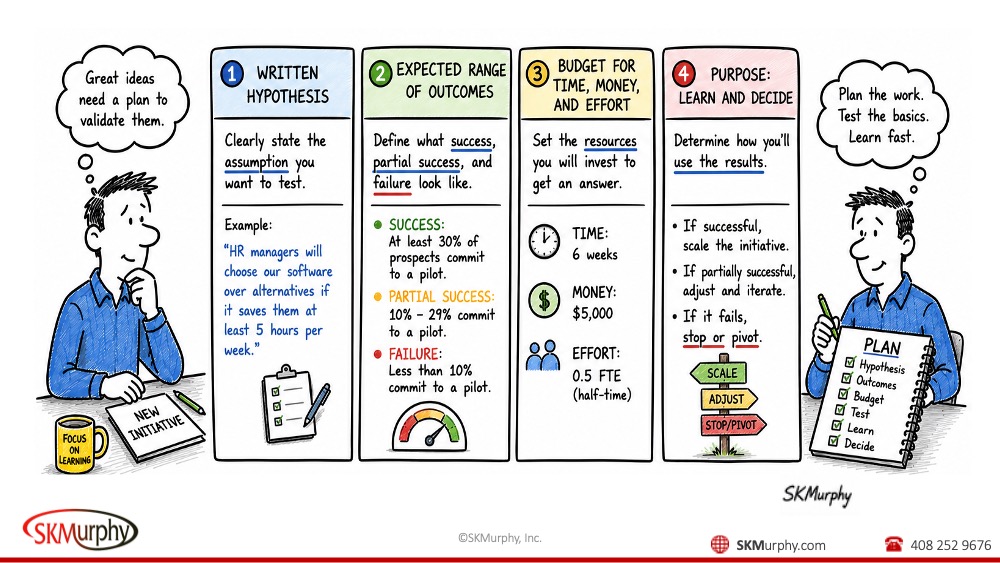
Effectual reasoning may not necessarily to increase the probability of success of new enterprises, but it reduces the costs of failure by enabling the failure to occur earlier and at lower levels of investment.
Entrepreneurs are entrepreneurial, as differentiated from managerial or strategic, because they think effectually; they believe in a yet-to-be-made future that can substantially be shaped by human action; and they realize that to the extent that this human action can control the future, they need not expend energies trying to predict it. In fact, to the extent that the future is shaped by human action, it is not much use trying to predict it–it is much more useful to understand and work with the people who are engaged in the decisions and actions that bring it into existence.
She highlights three key differences between effectual reasoning and traditional startup management models:
- Risk taking
- Traditional: expected return, work the plan to deliver results to your investors (”Ready Aim Fire” can become “Aim–not big enough–Aim–not big-enough–Aim…”).
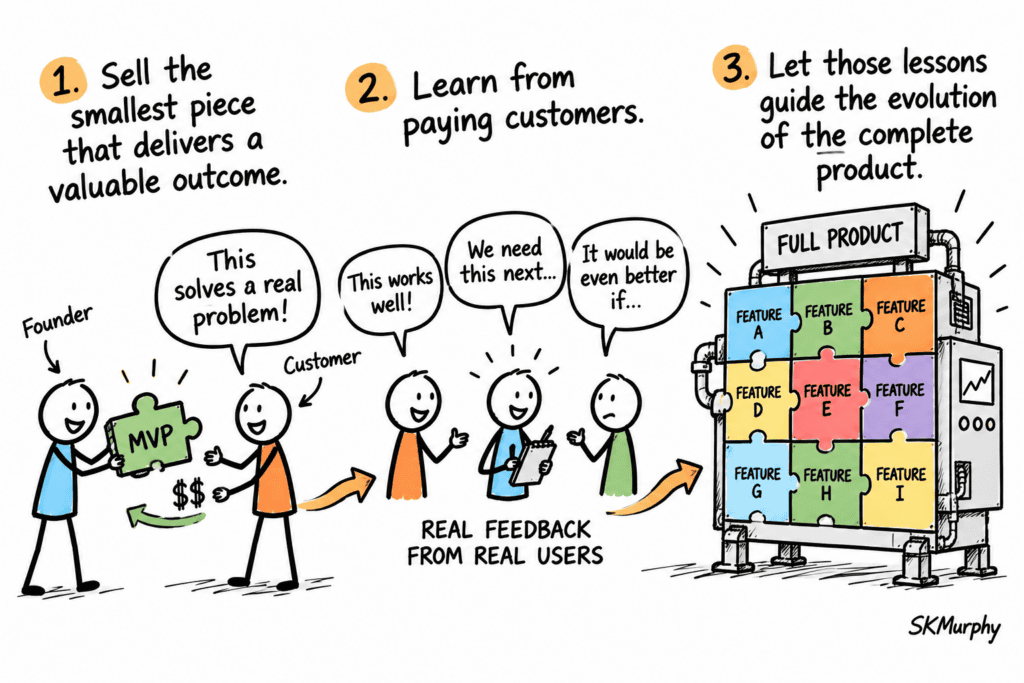
- Effectual: affordable loss, make many small mistakes as early and cheaply as possible to speed learning (”Ready Fire Steer“)
- Focus:
- Traditional: competition
- Effectual: strategic partnership (especially with early customers)
- Value Creation
- Traditional: rely on pre-existing knowledge to aim for a known market you can dominate and exploit
- Effectual: leverage contingencies; create opportunities as you map a new market
She goes into some detail on the “affordable loss principle” and offers extracts from an interview with an expert entrepreneur’s approach to a new market:
While managers are taught to analyze the market and choose target segments with the highest potential return, entrepreneurs tend to find ways to reach the market with minimum expenditure of resources such as time, effort, and money. In the extreme case, the affordable loss principle translates into the zero resources to market principle. Several of the expert entrepreneurs I studied insisted that they would not do any traditional market research, but would take the product to the nearest possible potential customer even before it was built. To quote but one of them, “I think I’d start by just… going… instead of asking all the questions I’d go and say.. try and make some sale. I’d make some… just judgments about where I was going — get me and my buddies — or I would go out and start selling. I’d learn a lot you know..which people.. what were the obstacles.. what were the questions.. which prices work better and just DO it. Just try to take it out and sell it. Even before I have the machine. I’d just go try to sell it. Even before I started production. So my market research would actually be hands on actual selling. Hard work, but I think much better than trying to do market research”.
In finding the first customer within their immediate vicinity, whether within their geographic vicinity, within their social network, or within their area of professional expertise, entrepreneurs do not tie themselves to any theorized or pre-conceived “market” or strategic universe for their idea. Instead, they open themselves to surprises as to which market or markets they will eventually end up building their business in or even which new markets they will end up creating.
This is also an approach that favors older entrepreneurs to the extent that they have larger social networks (based on more shared work experience with more people) and deeper professional expertise. The one caveat is that they have to be open to new possibilities and not be blinded by what they “know” to be true in the face of new information.
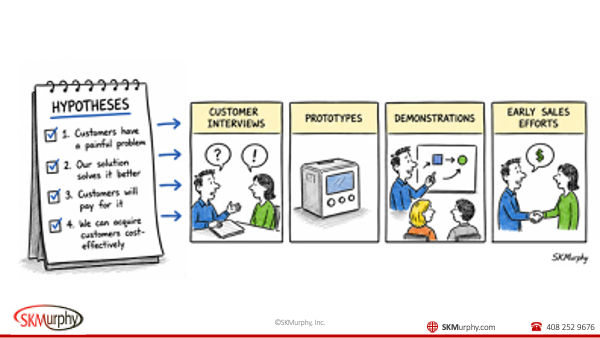
This 2001 paper offers another perspective on bootstrapping entrepreneurship that is independently derived and predates “Four Steps to the Epiphany (2003)”, “Blue Ocean Strategy(2005)”, and the “Sales Learning Curve (2004).” But all four are clearly addressing different aspects of the same core paradigm that takes a scientific or hypothesis driven approach to new products and new markets.
I will leave with two final quotes from the paper which highlights the value of establishing enduring relationships.
Expert entrepreneurs […] are actually in the business of creating the future, which entails having to work together with a wide variety of people over long periods of time. [They fill their future] with enduring human relationships that outlive failures and create successes over time
This is largely ignored in our entrepreneurship curricula which tend to focus on market research, business planning, new venture financing and legal issues. As far as I know no entrepreneurship programs offer courses in creating and managing lasting relationships or stable stakeholder networks, nor on failure management.
Related Posts
February 6th, 2010 09:57pm
Sean Murphy
This is a start articulating a set of resources that are for the most part not yet part of entrepreneurial thinking but that have had a significant impact on my perspective. I welcome any suggestions or lists from readers for what has influenced you, and opened you to new perspectives on your entrepreneurial journey.
What follows are my two year old answers, in no particular order to a question on Hacker News: Articles, Ideas, Books and/or Concepts that have changed your life.
I developed the list thinking about my approach to business and entrepreneurship, which is narrower than “life” and accounts for a lack of spiritual, marital, self-mastery, and personal improvement books and ideas.
- Myers-Briggs Model for Personality
- “Four Steps to the Epiphany” by Steve Blank
- John Boyd’s OODA Loop as a model for competitive decision making
- Decision Analysis techniques: in particular decision trees, expected value of perfect information, and “good decision, bad outcome.”
- BATNA (best alternative to a negotiated agreement) concept for negotiation planning
- “Secrets of Consulting” by Gerald M. Weinberg
- “Bionomics: Economy as Ecosystem” by Michael Rothschild
- SimCity computer game
- Analysis of Competing Hypotheses methodology
- wiki (social process) model for small team collaborative document development
- community of practice model for knowledge management
- “The Moon is a Harsh Mistress” by Robert Heinlein (in particular TANSTAAFL)
- activation energy, catalyst, and phase change concepts from physics/chemistry
- Amplify Positive Deviance model from Jerry Sternin (Save the Children)
- “The Empowered Manager” by Peter Block, in particular his trust vs. agreement matrix
- “Crossing the Chasm” & “Inside the Tornado” by Geoffrey Moore
- “Maneuver Warfare Handbook” by William Lind
- “Change Your Brain, Change Your Life” by Daniel Amen
- “Micromotives and Macrobehavior” by Thomas Schelling
- Appreciative Inquiry Techniques
Here are a few more techniques or perspectives that I have added upon some further reflection.
- Russell Ackoff’s Decision Record Model
- Gary Klein’s Premortem Technique
- Saras Sarasvathy’s Effectual Reasoning Model from What Makes Entrepreneurs Entrepreneurial
- Andrew Grove’s “High Output Management” in particular “always review drafts” and his model for one on one meetings.
- “Computers, Networks, and the Corporation” by Tom Malone and John F. Rockhart (1991 Scientific American Article)
- “The Computer and the Dynamo: The Modern Productivity Paradox in a Not Too Distant Mirror” Paul David (1989)
- “Gunfire at Sea” Elton Morison
- “Persistent Forecasting of Disruptive Technologies” by National Research Council (2010)
- “Technology Singularity” by Vernor Vinge, in particular the “Intelligence Amplification” section
February 5th, 2010 10:16pm
Theresa Shafer
Special Offer for Groups and Organization Members
Discounts are available for members of Bootstrappers Breakfast, Business Marketing Association, Women In Consulting, and organizations sending three or more employees: please contact us for discount codes.
Create and Deliver Surprisingly Compelling Software Demonstrations
“Do The Last Thing First” — the recipe for a Great Demo!
When: Wednesday March 17, 2010 8:15 am - 5:00 pm
Where: Moorpark Hotel, 4241 Moorpark Ave, San Jose CA 95129

This is an interactive workshop with Peter Cohan geared especially for you who demonstrate B-to-B software to your customer and channels. Bring a copy of your demo and be prepared to present it — we’ll help you turn it into a surprisingly compelling demo!
Cost (includes breakfast, lunch, copy of Peter Cohan’s “Great Demo!” book):
- Early Registration: $536
- After March 4: $560
This seminar outlines a framework for the creation and delivery of improved demos and presentations to enable increased success in the marketing, sale, and deployment of software and related products. Whether it’s face to face, in a webinar, as a screencast, or as a self-running demo the ability to present the key benefits of your software product is essential to generating prospect interest and ultimately revenue. Peter Cohan of The Second Derivative gives us the recipe for a Great Demo!
“I am confident that with the insights gained from your workshop we will land more customers in fewer iterations.”
Lav Pachuri, CEO, Xleron Inc.
“Peter Cohan’s Great Demo method really works. It helped us win DEMOgod, and it has allowed us to explain our offering much more clearly to prospects.”
Chaim Indig, CEO, Phreesia
(See “DEMOgod Winner Phreesia Praises Peter Cohan Training“)
|
ABOUT THE SPEAKER: Peter Cohan, Principal at Second Derivative
Community Web Site: www.DemoGurus.com
Peter Cohan is the founder and a principal of The Second Derivative, a consultancy focused on helping software organizations improve their sales and marketing results. In July 2004, he enabled and began moderating DemoGurus®, a community web exchange dedicated to helping sales and marketing teams improve their software demonstrations. In 2003, he authored Great Demo!, a book that provides methods to create and execute compelling demonstrations. The 2nd edition of Great Demo! was published March 2005.
Before The Second Derivative, Peter founded the Discovery Tools® business unit at Symyx Technologies, Inc., where he grew the business from an empty spreadsheet into a $30 million operation. Prior to Symyx, Peter served in marketing, sales, and management positions at MDL Information Systems, a leading provider of scientific information management software. Peter currently serves on the Board of Directors for Collaborative Drug Discovery, Inc. and the board of advisors for Excellin, Inc. He holds a degree in chemistry.
Peter has experience as an individual contributor, manage and senior management in marketing, sales, and business development. He has also been, and continues to be, a customer.
Agenda:
- 8:15 AM Breakfast & Registration
- 8:30 AM Workshop begins
- Noon Lunch & De-brief
- 1 PM Advanced Topics
- multiple solution demos
- presenting to a mixed audience with different needs or information requirements
- vision generation demonstrations
- handling bugs, crashes, and time challenges.
- 5 PM Wrap up
Seating is Limited These are intensive sessions and we ask that you arrive at least 15 minutes before 8:30AM start time to ensure you will have a seat and won’t disrupt the session once it is underway.
For more information: Theresa Shafer 408-252-9676 events@skmurphy.com
February 3rd, 2010 07:57pm
Sean Murphy
A client was kind enough to invite me to hear Jenny Allen present an abbreviated but very moving version of her one woman stage play “I Got Sick Then I Got Better” at a luncheon held by the Canary Foundation today. Mrs. Allen spoke candidly of her experience surviving cancer. Two different cancers actually. She was diagnosed with endometrial cancer and underwent a hysterectomy to treat it. Analysis of the tissue from her hysterectomy uncovered stage IIc ovarian cancer.
She is a writer so she kept a diary of her experiences. She went back to re-read her journal page for the day she was diagnosed with ovarian cancer, expecting to find her thoughts and impressions. All she had written was “Very Bad News.” That’s more than four years ago now and in the interim she has turned her emotional turmoil into a funny, painfully honest, and incredibly moving one woman stage play.
It moved me to tears more than once. I would hope to have the same strength of purpose to be able to transmute so much anxiety and suffering into something as honest and funny and uplifting. If you have a chance to see her play, I would not miss it.
And if during these recessionary times you can spare a nickel for improving the early detection of cancer, the Canary Foundation can put it to good use.
February 2nd, 2010 12:03am
Sean Murphy
Literature is mostly about having sex, and not much about having babies; life is the other way round.
David Lodge
Startup pundits have focused primarily on funding events and product launches, and not much about how viable the business model and scale up strategy are. Successful businesses are the other way around.
Jeff Nolan wrote in January 2009 about “Why the TechCrunch Economy Will Falter” noting (bold in original):
“…a fundamental flaw in the startup economy promoted by a wide swath of pundits and proponents, that starting is more important than sustaining.”
Martin Edic in the comments noted that
The other half of this situation is the ‘pundit’ sites lack of aggressively asking companies exactly how they are going to make money. Endless coverage of start-ups that are more about a gimmick, reiteration of an original technology or an imitation of something else, without questioning the viability of the business model, helps create an environment where typically young entrepreneurs scoff at the need for revenue. When we hit a downturn like this and funds dry up, they are going to fold.
The good news it that most serial entrepreneurs fail at least once and return as much more knowledgeable and pragmatic business owners. So covering failure has its purpose.
It’s taken a little more than a year but Dave McClure notes yesterday in “Subscriptions Are The New Black”
We have largely WASTED an entire web decade of time, energy & venture capital on extremely inefficient revenue models. There have been a few interesting examples of startups acquired in the 00’s for large amounts due to amazing growth (eGroups, MySpace, Skype, YouTube) or advertising potential (aQuantive, DoubleClick, AdMob, RightMedia). However, mostly the decade has been an uninterrupted string of uninspiring business models and small-time acquisitions of Web 2.0 startups filled with rainbows & unicorns, rather than those based on simple, transactional revenue models.
and he posits two key assertions related to startup business models:
- The default startup business model from 2000-2009 was based on growth (aka acquisition) and CPM- or CPC-advertising
- The default startup business model for 2010 & beyond will be subscriptions and transactions (e-commerce, digital goods).
What does this mean for the average bootstrapping entrepreneur?
- More competition as fewer teams bet on “build it and they will come” models and start competing to deliver services that firms or individuals will pay for today.
- Perhaps less derision when they tell other startup entrepreneurs that they plan to charge right away.
- Craig Newmark’s answer “Our history is slow, continuous growth. In the race between tortoise and hare, well, we’re the slow guy” to “How Craigslist Spread” is worth keeping as your screen saver quote.
Related posts
February 1st, 2010 06:21am
Sean Murphy
I answered a question recently for real examples of teams using customer development approaches to software startups and drafted the following reply
First Example: Michael Sippey of Six Apart
I blogged about an August 2006 talk by Michael Sippey of SixApart in January of 2007 at SVPMA (his slides are here http://www.svpma.org/eventarchives/sixapart.pdf )
If you read through Michael’s slides and my notes from his talk you will see that he offers four stories of new product introduction:
- Moxy, based on getting out of the building and watching how customers used other products
- A next generation jukebox, based on raising a lot of money and building something that was cool but not compelling
- TypePad’s “Big Bang” where they launched a major release with many new features, some of which didn’t work
- TypePad’s transition to a fast iteration model where they launch a few features on a two week cycle
Sippey never mentions Steve Blank or customer development but he is following many of the key methodology principles of customer development in his two success stories. For example, here are some of his key questions (note the focus on getting out of the building, a sequence of demos/prototypes, the focus on customer pain/problem, and asking the customer to prioritize features):
How we did it.
- Find 30 prospects. Set up meetings.
- Demo your idea / alpha / beta / product.
- Ask questions. (Lots of questions.)
- Take copious notes. Score your results.
Critical questions.
- Do you have this problem?
- Does this solve your problem?
- How much would you pay for this?
- Base hit or home run?
- How would you spend $100 of our money?
Second Example: Dave Stubbenvol of Wowzamedia
I interviewed Dave Stubbenvol in January 2008. Dave is CEO of Wowzamedia and a five time serial entrepreneur. Again, without mentioning Steve Blank he outlines how he has followed customer development principles in building Wowzamedia to a successful bootstrapped company. Here is a long excerpt where he outlines their focus on trying things and seeing if they are of use:
Q: It seems like you have had a clear sense of priorities with WOWZA?
With WOWZA our focus is on three key things: making sure that we will be around, making sure that we are meeting customer needs today, and staying flexible enough to meet customer needs for the future.
Q: I talk to many entrepreneurs who take a “if I build it they will come approach.” We met just over a year ago, before you had even launched. Can you talk about the amount of preparation, the strategies, and your implementation plan just to get ready for launch?
This time with WOWZA, launch was sort of a crazy thing for us. We basically started the company because we wanted to explore the possibilities for new applications that emerging media technologies enabled. Originally, we never actually expected to make money with what we built. Not really your typical way of starting a business.
My co-founder and I had prototyped a hybrid video blogging system. It was this unholy hybrid of WordPress, the Adobe Flash Communication Server, and then Flash Media Server. While messing around, we found out that Adobe Flash Communication Server, Flash Media Server was just not good enough. The product wasn’t stable enough, it was unreliable, it had lousy performance, it was ridiculously expensive, and it just was not good enough for us. So, we decided to write our own, and we put that into our product.
Prior to launch we did all the standard things like press releases, some advertising, having reference customers, having customers ready to buy on the launch date, and building up the market. However, we did not pour boatloads of money into the initial marketing. For two reasons: first we figured we would get it wrong at the start, and second we felt that this was a one off product. Our primary intention was to establish the company and build a reputation. We want to be the guys who know what they are doing, tell you the truth, and deliver a damn good product. The truth is with a one off product there are going to be problems, no doubt about it. We went ahead and launched in February 2007, got out there, got press in a couple of places, people came, and we made sales.
These two data points for companies that still around and growing. They don’t mention that they follow “Four Steps” but both are clearly following the key principles of customer development for the customer discovery and customer validation phases. This should help substantiate that successful firms have followed customer development principles.
We follow them in working with our clients (I should make clear that neither SixApart nor Wowza were or are clients) who are primarily teams of two to five engineers. They find a “scientific approach” to the early market that involves focused experimentation to be very useful.
January 31st, 2010 06:06am
Sean Murphy
Get them while they are hot on http://www.twitter.com/skmurphy
“Fallacies do not cease to be fallacies because they become fashions.”
G. K. Chesterton
“No amount of sophistication is going to allay the fact that all your knowledge is about the past and all your decisions are about the future.” Ian E. Wilson
“Just because you’re good at something doesn’t mean the market cares any longer.” Seth Godin “Learnng from Groucho Marx”
- “Just because you’re good at something doesn’t mean the market cares any longer. It’s extremely difficult to repair the market. Find a market that will respect and pay for the work you can do. Technology companies have been running this race for years. Now, all of us must.
“To sway an audience, you must watch them as you speak.” C. Kent Wright
- This is from the introduction to his book “Unaccustomed as I am…“ an anthology of quotes for “after dinner speakers.” He offers it as item 6 in a list of 7 “don’ts.”
- 6. Don’t in any circumstances read your speech, but speak from notes if you must. To sway an audience, you must watch them as you speak.”
“How did you go bankrupt?” “Two ways, gradually and then suddenly.”
Ernest Hemingway “The Sun Also Rises”
“It is not written anywhere that raising money is the first step in starting a company. Or any step at all.” Venture Hacks
- This was a tweet from their twitter feed that is not attributed and doesn’t appear on their site. I assume that it is original with Nivi or Naval.
“I’m not happy. I’m cheerful. There’s a difference. A happy woman has no cares at all. A cheerful woman has cares but has learned how to deal with them.” Beverly Sills
“A million man years has been spent on Artificial Intelligence.”
Monica Anderson in “Could AI Be Easy?”
“On average you have to earn 2.5X to be as happy working for someone else as working for yourself.” Scott Andrew Shane in “The Illusion of Entrepreneurship: the Costly Myths that Entrepreneurs, Investors, and Policy Makers Live By”
- Full quote “There’s another reason that people aren’t necessarily foolish when they start businesses, despite the poor financial performance of the average startup. Entrepreneurship provides a very important non-financial benefit: it makes people happier. […] In fact, studies show that to be as satisfied when he is working for others as he is when he is working for himself, the average person needs to earn two-and-a-half times as much money!”
- What makes entrepreneurs more satisfied:
- Flexibility to work and care for small children at the same time
- Working in a small organization where they can interact directly with everyone in the company
- the autonomy, flexibility, and greater control over their lives
- By implication, if entrepreneurs can offer flexibility, interaction with everyone on the team, autonomy they can compete more effectively for employees.
“We don’t encourage people to quit their jobs, gainful employment is a legitimate funding vehicle in this financial market.” Adeo Ressi of the Founder Institute in “Silicon Valley’s New Sport: Extreme Bootstrapping”
“The universe is run by the complex interweaving of three elements: energy, matter, and enlightened self-Interest.”
J. Michael Straczynski
“In the future, everyone will be famous for 15 people”
Momus (Nick Currie) in “Pop Stars Neine Danke“
“I have been described as ‘impatient for action, but patient for results.’”
John Bogle in “On Leadership”
January 20th, 2010 06:43pm
Sean Murphy
In a long and somewhat rambling blog post “Customer Development and the Lean Startup,” that contains a long laundry list of resources for entrepreneurs on Customer Development and Lean Startup resources, Yury Tsukerman lists “the key players” and drops this short comment
Sean Murphy – I don’t read him regularly, but I hear that I should.
Not since Techdirt used me in a promotional picture (see “Born with a Face Made for Podcasting“) have I felt such a sense of warm endorsement. So here is a tip for my 15 readers on how to deal with your 285 nano-centuries of fame: add a nice comment to the bottom of the blog. Which I did:
I think a post that describe how you have applied a subset of these principles and what you have learned would be very useful, it’s clear that you have your own insights on these topics.
There is a good conversation going on in the Lean Startup Circle, it would be great to see you take part.
I have a blog category devoted to Customer Development if you are interested.
If you are having trouble finding time to read my blog here are five posts that I believe represent the range of my writing. Clearly I need to take a page out of the Venture Hacks notebook and create an index for the 550 posts I have written over the last four years.
But it’s been a few weeks and I am not closer to my master index so I would appreciate your help. Let me know which of my blog posts you found especially useful (or an old one now desperately in need of a re-write/update) and any areas or topics you would like to see me address.
Notes
- “In the future, everyone will be famous for 15 people” Momus (Nick Currie) in “Pop Stars Neine Danke“
- One handy conversion factor to remember is Tom Duff’s “Pi seconds is a nanocentury.“
- “In the future everyone will be famous for 15 minutes” Andy Warhol
- Fewer footnotes probably not a bad idea either.
January 19th, 2010 05:50pm
Sean Murphy
Great post by Linsday Robertson on “The Do’s and Don’ts of Online Publicity, For Some Reason” where she lists nine rules of thumb for getting publicity. Here were my top three from here list (numbers are from the original: read the whole thing):
1. FOR IMMEDIATE RELEASE means FOR IMMEDIATE DELETE to any blogger with any influence. Period.
3. A blogger’s resistance to marketing/publicity is directly proportionate to his or her influence as a blogger.
4. A Monkey Can Send a Mass Email: Build Relationships and Understand What Your Real Job Is
Some related posts:
January 18th, 2010 09:40pm
Theresa Shafer
Create and Deliver Surprisingly Compelling Software Demonstrations
“Do The Last Thing First” — the recipe for a Great Demo!
When: Wednesday March 17, 2010
- AM Session: 8:15 am - 1:00 pm
- PM Session: 1 - 5pm Advanced Topics (see below)
Where: Moorpark Hotel, 4241 Moorpark Ave, San Jose CA 95129

This is an interactive workshop with Peter Cohan geared especially for you who demonstrate B-to-B software to your customer and channels. Bring a copy of your demo and be prepared to present it — we’ll help you turn it into a surprisingly compelling demo!
AM Session Cost (includes breakfast, lunch, copy of Peter Cohan’s “Great Demo!” book):
- Early Registration: $336
- After March 4: $360
This seminar outlines a framework for the creation and delivery of improved demos and presentations to enable increased success in the marketing, sale, and deployment of software and related products. Whether it’s face to face, in a webinar, as a screencast, or as a self-running demo the ability to present the key benefits of your software product is essential to generating prospect interest and ultimately revenue. Peter Cohan of The Second Derivative gives us the recipe for a Great Demo!
“I am confident that with the insights gained from your workshop we will land more customers in fewer iterations.”
Lav Pachuri, CEO, Xleron Inc.
“Peter Cohan’s Great Demo method really works. It helped us win DEMOgod, and it has allowed us to explain our offering much more clearly to prospects.”
Chaim Indig, CEO, Phreesia
(See “DEMOgod Winner Phreesia Praises Peter Cohan Training“)
ABOUT THE SPEAKER: Peter Cohan, Principal at Second Derivative
Community Web Site: www.DemoGurus.com
Peter Cohan is the founder and a principal of The Second Derivative, a consultancy focused on helping software organizations improve their sales and marketing results. In July 2004, he enabled and began moderating DemoGurus®, a community web exchange dedicated to helping sales and marketing teams improve their software demonstrations. In 2003, he authored Great Demo!, a book that provides methods to create and execute compelling demonstrations. The 2nd edition of Great Demo! was published March 2005.
Before The Second Derivative, Peter founded the Discovery Tools® business unit at Symyx Technologies, Inc., where he grew the business from an empty spreadsheet into a $30 million operation. Prior to Symyx, Peter served in marketing, sales, and management positions at MDL Information Systems, a leading provider of scientific information management software. Peter currently serves on the Board of Directors for Collaborative Drug Discovery, Inc. and the board of advisors for Excellin, Inc. He holds a degree in chemistry.
Peter has experience as an individual contributor, manage and senior management in marketing, sales, and business development. He has also been, and continues to be, a customer.
Agenda:
- 8:15 AM Breakfast & Registration
- 8:30 AM Workshop begins
- Noon Lunch & De-brief
- 1 PM Wrap up
Seating is Limited These are intensive sessions and we ask that you arrive at least 15 minutes before 8:30AM start time to ensure you will have a seat and won’t disrupt the session once it is underway.
PM Session: Advanced Topics
In response to requests for assistance on demo delivery we have added an afternoon session to our Great Demos workshop. If this is your first exposure to the Great Demo come for the morning and get a great overview of the methodology and stay for the afternoon if you would like an opportunity for more interactive training on advanced topics such as multi-solution, multi-player demonstrations, and vision generation demonstrations. The advanced topic session as covers real life issues like handling bugs, crashes, and time challenges.
This is an interactive workshop with Peter Cohan is only available to people who have already attended the morning session or a previous Great Demo session.
When: Wednesday March 17, 2010 1:00 - 5:00 pm
Where: Moorpark Hotel, 4241 Moorpark Ave, San Jose CA 95129
Cost $200
click here to Register for the Advanced Topics
Advanced Topics Agenda:
- 1 PM Advanced Topics
- multiple solution demos
- presenting to a mixed audience with different needs or information requirements
- vision generation demonstrations
- handling bugs, crashes, and time challenges.
- 5 PM Wrap up
For more information: Theresa Shafer 408-252-9676 events@skmurphy.com
Previous Posts